
The Sagamore Bridge requires urgent reconstruction because it’s approaching 90 years in service with deteriorating structural elements while handling 300% beyond its design capacity. You’ll face safety risks from its substandard lane widths, compromised load capacity, and inability to meet modern seismic standards. The bridge creates critical evacuation limitations and economic bottlenecks for Cape Cod’s tourism economy. The planned $2.4 billion reconstruction offers advanced engineering solutions that will transform regional mobility for decades.
Key Takeaways
- The 90-year-old bridge is deteriorating with damaged concrete T-beams, gusset plates, and broken anchor bolts requiring urgent replacement.
- Current traffic volumes exceed original design capacity by 300%, causing safety concerns and accelerating structural deterioration.
- The bridge fails contemporary safety standards with substandard lane widths and inadequate barriers, compromising driver safety.
- The existing structure cannot support evacuation needs during emergencies, creating a critical vulnerability for Cape Cod residents.
- Reconstruction will introduce modern multi-modal transportation options while reducing bottlenecks that harm the regional tourism economy.
Historical Context and Aging Infrastructure Concerns
When the original Sagamore Bridge opened alongside the Cape Cod Canal in 1916, it represented a significant but ultimately flawed engineering solution.
You’re looking at an infrastructure legacy that began with a drawbridge featuring two eighty-foot cantilever spans providing merely 140-foot navigational openings—inadequate for the canal’s swift currents.
This historical significance intensified when the U.S. Army Corps of Engineers assumed canal operations in 1928, determining that fixed structures with greater clearance were essential.
By 1933, construction began on the current bridge, which opened in 1935 with a 616-foot main span offering 135-foot clearance.
Today’s bridge, approaching its 90th year of service, carries four lanes of traffic that far exceed its original design capacity, underscoring why modern reconstruction has become critical. The planned replacement, expected to begin construction in 2027, will be located west of the existing span and will transfer ownership from federal jurisdiction to the state of Massachusetts.
Current Structural Assessment and Safety Implications
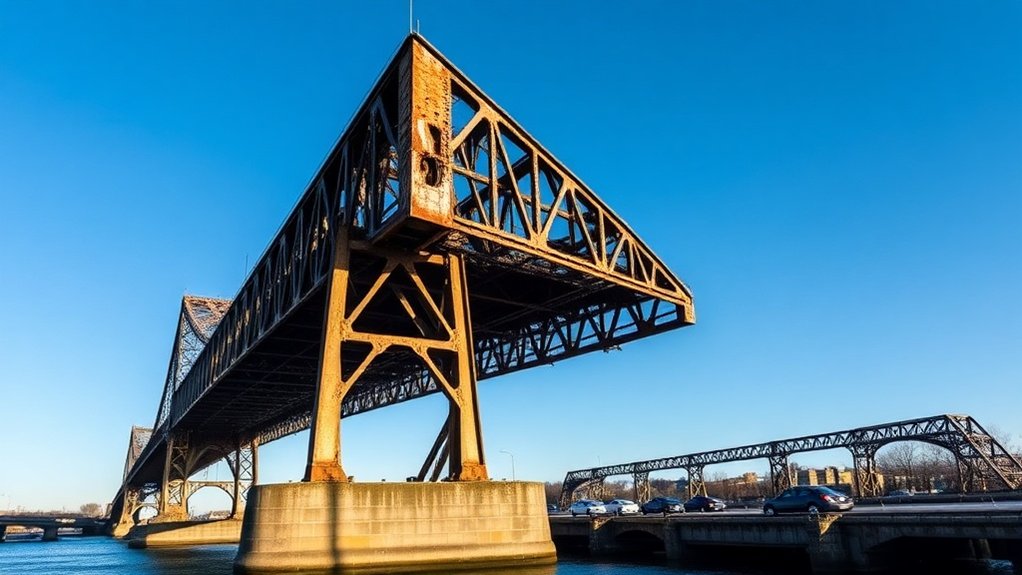
You’ll find that the Sagamore Bridge’s « fair » condition rating masks significant structural concerns, including deteriorating concrete T-beams, damaged gusset plates, and broken anchor bolts at truss expansion bearings.
The current structure fails to meet contemporary safety standards with its substandard lane widths, steep approach grades, and inadequate safety barriers that increase collision risks. As the only vehicular connection to and from Cape Cod, its structural integrity is critical for tourism, emergency evacuations, and daily commuters.
Daily traffic volumes consistently exceed the bridge’s original design capacity, accelerating deterioration of critical structural elements and compromising the safety margin intended in its 1930s engineering specifications.
Deterioration vs. Public Safety
While the Sagamore Bridge maintains a « Fair » condition rating according to recent U.S. Army Corps of Engineers assessments, this classification masks critical deterioration impacts threatening public safety.
You’ll find concrete T-beams exhibiting decay alongside gusset plates showing significant section loss from pack rust. Broken anchor bolts at truss expansion bearings further compromise structural integrity.
Beyond physical deterioration, the bridge fails to meet modern safety standards with inadequate barriers, substandard lane widths, and minimal pedestrian accommodations. These deficiencies create hazardous conditions for all users.
The Corps’ 2020 report concluded that rehabilitation can’t adequately address these concerns, making replacement the « most reliable, fiscally responsible solution. »
Safety enhancements through reconstruction would bring the structure into compliance with contemporary design standards while eliminating persistent functional obsolescence issues that rehabilitation can’t resolve.
Stress Load Exceeding Design
The Sagamore Bridge‘s original 1913 design parameters have been overwhelmingly exceeded by current traffic volumes, creating dangerous structural stress conditions beyond intended capacity limits.
The bridge now handles twenty times its intended traffic while failing to meet modern AASHTO load rating requirements.
You’ll notice the bridge’s substandard lane widths and inadequate safety barriers aren’t merely inconvenient—they’re indicators of compromised structural integrity under excessive load demands.
Recent foundation testing using Osterberg Cells reveals concerning load capacity issues, with critical elements requiring replacement based on unsatisfactory reliability ratings.
The $6.5 million foundation assessment confirms what engineers have documented: substructure components are stressed beyond original parameters, and the bridge’s inability to meet contemporary seismic standards further compromises its viability under current operational demands.
Strategic Funding Allocation and Financial Planning
The federal-state funding architecture for Sagamore Bridge replacement follows a strategic sequencing that prioritizes the northbound span through a $1.72 billion federal investment package complemented by $700 million in state matching funds.
You’ll observe that this allocation strategy addresses immediate structural concerns while establishing a phased implementation framework that maximizes available fiscal resources within the broader $4.5 billion dual-bridge replacement initiative.
Despite securing $2.4 billion in combined commitments, your attention should focus on the remaining $2.1 billion funding gap that requires resolution for complete project execution within the governor’s proposed eight-year timeline.
Funding Sequence Strategy
Following strategic revisions in 2023, officials recalibrated their application approach to focus exclusively on the Sagamore Bridge, abandoning the previous joint Bourne-Sagamore proposal framework.
This separation enhanced competitiveness under the Bridge Investment Program‘s $100M+ project threshold, strategically positioning the $2.13B Sagamore replacement to secure funding sources first.
You’ll find this sequencing aligns with traffic priorities, as Sagamore’s 38M annual trips warrant immediate attention.
The strategy has already yielded $1.72B in federal commitments through multiple grant competition channels: $993M from the Bridge Investment Program, $727M via the « Mega » Program, and $350M from USACE allocations.
Massachusetts has pledged $700M in matching funds, with $262M programmed for 2024-2028 to synchronize with the projected 2027 construction start.
Budget Allocation Priorities
While federal commitments have secured $1.72 billion toward the Sagamore Bridge replacement, strategic budget allocation remains critical to addressing the $2.08 billion funding gap across the full $4.5 billion Cape Cod Bridges Program.
You’ll notice funding transparency is evident in the breakdown: $1.365 billion specifically targets Phase 1 (Sagamore), requiring approximately $735 million in additional funding.
Massachusetts has prioritized budget efficiency by committing $700 million in state funds, structured to maximize federal grant eligibility. This approach leverages the $1 billion Bridge Investment Program award and $372 million from Multimodal Discretionary Grants.
The economic justification for prioritizing Sagamore Bridge is clear—handling over 20 million annual vehicle crossings makes it a critical infrastructure investment compared to the $775 million that would otherwise be needed for 50 years of maintenance.
Traffic Management and Regional Mobility Impacts
As critical infrastructure supporting a multi-billion dollar regional tourism economy, the Sagamore Bridge currently functions as a significant bottleneck with traffic volumes exceeding its 1935 design capacity by over 300 percent.
The reconstruction will implement advanced traffic management systems including over-height detection, dynamic lane control, and queue warning systems to optimize traffic flow.
You’ll experience reduced crash rates through these modernizations, bringing incidents below state-wide averages.
The new design integrates multi-modal transportation with dedicated shared-use paths for pedestrians and cyclists—amenities previously unavailable.
During construction, phased approaches will maintain two operational lanes in both directions, with special consideration for seasonal tourism demands.
Most critically, the redesigned bridge will correct current emergency evacuation limitations, ensuring minimum 50 percent capacity during crisis situations while eliminating recurring bottlenecks during peak periods.
Advanced Engineering Approach and Construction Timeline
The Sagamore Bridge reconstruction employs innovative twin-bridge architecture with a distinctive W configuration for support legs, representing a significant departure from conventional single-structure designs.
This approach distributes the 12.5 million pounds of structural load more efficiently while positioning critical infrastructure further outside the navigation channel—a direct response to lessons from the 2024 Francis Scott Key bridge collapse.
You’ll benefit from advanced fabrication techniques where main spans are created off-site before being transported via marine vessels to their final position.
This modular construction methodology mirrors the successful Lake Champlain Bridge replacement, minimizing traffic disruption by maintaining two operational lanes in each direction throughout construction.
The phased approach allows for sequential replacement without long-term closures, while the twin arch design delivers both cost efficiency and a shortened construction timeline compared to alternatives.
Environmental Review Process and Public Engagement
Following federal and state requirements, the Sagamore Bridge reconstruction undergoes a comprehensive environmental review process combining NEPA and MEPA frameworks under the One Federal Decision structure.
MassDOT has filed the Draft Environmental Impact Statement, marking a significant federal review milestone as the project advances through Phase 3.
The environmental assessment examines air quality, coastal zone consistency, visual impacts, and effects on marine life and historical assets. You’ll find these analyses in DEIS Chapter 4 and supporting appendices.
Regulatory compliance involves coordination between the Federal Highway Administration and agencies like the Army Corps of Engineers and NOAA.
Public participation opportunities include a 45-day comment period through January 5, 2026, an interactive summary site, and a public hearing at Massachusetts Maritime Academy on December 16.
You can submit comments via online forms or the interactive platform.