
Selecting the right concrete mix requires assessing your structural needs and environmental conditions. For residential foundations, C20 provides adequate strength, while commercial structures need C30 or higher. Consider specialized options like UHPC for critical infrastructure or SCC for heavily reinforced elements. Balance workability with durability by managing water-cement ratios and incorporating additives like polycarboxylate ethers. Sustainable alternatives with SCMs can reduce carbon footprint by up to 40% while enhancing performance characteristics. The optimal mix decision impacts your structure’s entire service life.
Key Takeaways
- Match concrete strength class (C10-C40) to your specific application requirements, considering load-bearing needs and environmental exposure.
- Evaluate specialized mixes like UHPC for critical infrastructure or SCC for heavily reinforced structures requiring superior finishes.
- Consider performance indicators including freeze-thaw resistance, chloride penetration, and scaling resistance when selecting mix designs.
- Incorporate advanced additives such as polycarboxylate ethers or air-entraining agents to optimize strength, durability, and workability.
- Balance environmental impact by utilizing sustainable options like SCM blends or recycled aggregates without compromising structural performance.
Understanding Concrete Strength Classifications (C10-C40)
The backbone of modern construction, concrete strength classifications provide a standardized framework for specifying appropriate materials based on structural requirements.
When you examine the UK’s BS 8500 system, you’ll notice the « C » prefix followed by a number indicating compressive strength in N/mm² after 28-day curing.
C10 applications include blinding layers and non-structural pathways, while C20 characteristics make it suitable for residential foundations and domestic driveways.
C25 uses center on standard domestic structural elements, with C30 advantages becoming apparent in commercial applications requiring moderate load-bearing. Proper selection of concrete grade helps prevent structural failure while avoiding unnecessary costs.
C35 specifications typically cover multi-story buildings and bridge construction, featuring reduced water-cement ratios.
C40 requirements are the most stringent, often incorporating silica fume and performance additives for high-rise structures and chemically harsh environments.
Key Performance Indicators for Structural Concrete
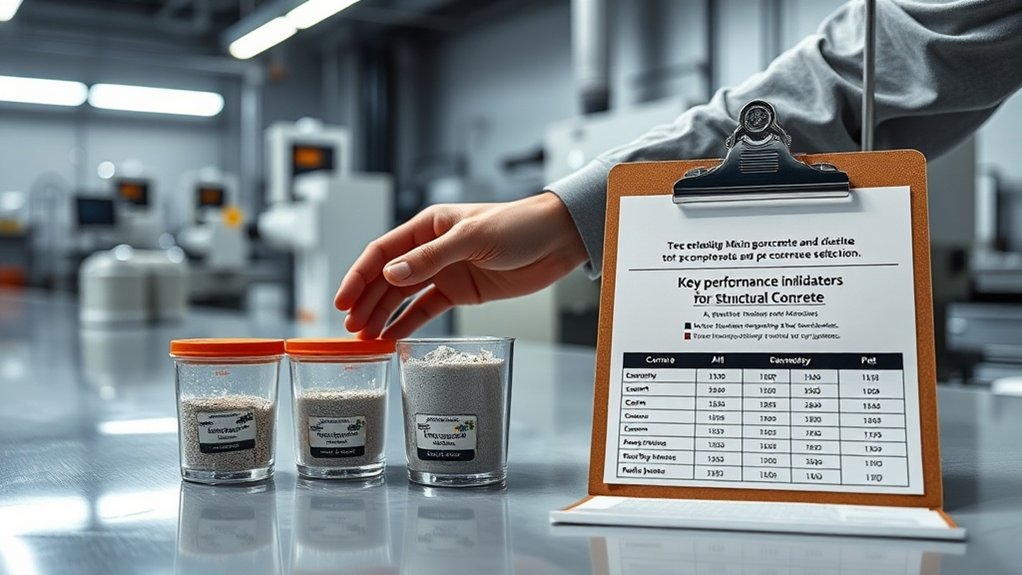
Beyond the baseline C-ratings that define concrete strength, successful structural concrete implementation hinges on specific key performance indicators that address both immediate performance and long-term durability.
You’ll need to evaluate freeze-thaw resistance through relative dynamic modulus testing (minimum 60% after 300 cycles), scaling resistance via ASTM C 672, and chloride ion penetration resistance—all critical durability metrics.
Performance-based specifications now drive most modern concrete requirements, with exposure classifications directly determining minimum strength requirements and material parameters.
When verifying structural performance, nonlinear response history analysis becomes essential, particularly in seismic applications. ACI 318-19 introduces performance-based design metrics for evaluating and verifying seismic resistance in concrete structures.
For high-performance concrete, you’ll need to meet elevated standards, including modulus of elasticity thresholds of 34 GPa and specific durability testing requirements reflecting extended service life expectations.
Canadian CSA A23.1 and AASHTO R101 standards offer comprehensive performance metrics frameworks.
Specialized Concrete Mixes for Demanding Applications
Ultra-High Performance Concrete offers you exceptional compressive strengths exceeding 150 MPa for critical infrastructure projects where traditional concrete would fail under extreme loading conditions.
Self-Compacting Concrete eliminates vibration requirements while achieving superior compaction rates in heavily reinforced structures, reducing your placement costs by up to 25%.
When selecting between these specialized mixes, you’ll need to evaluate specific project demands including load requirements, reinforcement density, and long-term maintenance considerations.
UHPC for Infrastructure Projects
Revolutionary in its performance capabilities, Ultra-High Performance Concrete (UHPC) has transformed modern infrastructure development through its exceptional strength and durability characteristics.
You’ll find UHPC applications in over 300 U.S. bridges, where it enables thinner structural elements while maintaining load capacity. Its five-fold strength advantage and ten-fold wear resistance make it ideal for prestressed girders, precast waffle panels, and connection joints.
UHPC benefits extend beyond structural performance to economic and environmental advantages.
Despite higher initial costs, you’ll realize savings through reduced material consumption (58% compared to conventional concrete), accelerated construction timelines, and dramatically extended service life.
The material’s superior resistance to weathering, frost, deicing salts, and chloride intrusion significantly reduces maintenance requirements, making UHPC a cost-effective solution for sustainable infrastructure projects.
SCC Applications
Self-Consolidating Concrete (SCC) offers exceptional versatility for applications where traditional vibration techniques prove impractical or insufficient.
You’ll find SCC particularly valuable in heavily reinforced structural elements like bridge components and nuclear containment structures where dense reinforcement requires complete encapsulation without voids.
For architectural applications, SCC delivers high-quality surface finishes without blemishes, making it ideal for exposed facades and complex shapes.
The self-compacting benefits extend to challenging formwork scenarios, including curved elements and confined spaces where vibration equipment can’t reach effectively.
Consider SCC for high-rise building cores, seismic-resistant structures, and infrastructure projects demanding consistent quality.
While application challenges include specialized mix design requirements, the productivity benefits are substantial—reduced placement time, decreased noise levels, and lower labor requirements, especially beneficial in urban construction settings with limited access.
Environmental Considerations in Concrete Selection
You’ll need to assess your concrete mix’s global warming potential, with cement production accounting for 70-90% of emissions and industry averages of 288.90 kg CO2-eq per cubic yard for 5,000 psi mixes.
Consider sustainable alternatives like high-SCM content mixes that can reduce emissions by up to 67% while enhancing durability through decreased permeability and extended service life.
Environmental Product Declarations (EPDs) provide standardized benchmarks to quantify your mix’s carbon footprint across multiple impact categories, enabling comparison against regional performance targets.
Climate Impact Assessment
When selecting concrete for your project, a thorough climate impact assessment provides essential insights into the environmental footprint of different mix designs.
Follow standardized approaches like ISO 14040/14044 for Life Cycle Assessment (LCA) to evaluate impacts throughout the concrete’s lifecycle.
Measure climate metrics using Global Warming Impact (GWI) expressed in kg CO2-eq per functional unit or Product Carbon Footprint (PCF) per cubic meter.
You’ll need to collect primary data including raw material quantities, cement type, and transportation distances.
Apply appropriate emission factors for components like Portland cement (900 kg CO2e/ton), fly ash (56 kg CO2e/ton), and slag (220 kg CO2e/ton).
For comprehensive assessment, consider using automated LCA software rather than labor-intensive spreadsheets, especially for larger projects requiring real-time tracking and reporting.
Sustainable Mix Options
Selecting environmentally responsible concrete mixtures requires understanding the diverse array of sustainable options available in today’s market.
You’ll find significant benefits by incorporating industrial by-products like fly ash, GGBFS, and silica fume as supplementary cementitious materials, reducing embodied carbon by up to 40% compared to traditional Portland cement.
Consider recycled concrete aggregate (RCA) for non-structural applications, which diverts construction debris from landfills while achieving a 60% reduction in cement content.
Low carbon alternatives like multi-SCM blends optimize durability without compromising performance.
Water conservation through water-reducing admixtures can decrease mixing requirements by 15-25%, while permeable mixes manage stormwater runoff effectively.
For maximum sustainability, look for mixes that leverage production efficiencies like AI-optimized batching and fiber reinforcement to reduce overall concrete volume.
Balancing Workability and Durability in Mix Design
Finding the optimal balance between workability and durability represents one of the most critical challenges in concrete mix design. You’ll face significant workability trade-offs when adjusting water-cement ratios—lower ratios enhance strength but reduce flowability, while excessive water weakens the structure.
These durability challenges manifest in increased cracking risks and premature deterioration. Your aggregate selection directly impacts this balance. Fine aggregate grading affects workability more significantly than coarse aggregate variations. Following the 4:2:1 rule (coarse aggregate:sand:cement) helps achieve ideal particle packing while maintaining proper workability.
Consider your application when selecting workability levels. Low-slump mixes suit foundations, medium workability (50-100mm slump) works for general construction, while high-workability concrete requires careful stability control.
Improper balance inevitably leads to segregation, poor consolidation, and compromised long-term performance.
Advanced Additives and Their Impact on Concrete Properties
Modern concrete technology has evolved dramatically through the development of specialized chemical additives that transform basic mixes into high-performance materials.
Polycarboxylate ether polymers and sulfonated naphthalene formaldehyde condensates offer exceptional water reduction while maintaining flowability, increasing strength by up to 25%.
Understanding additive interactions is crucial for performance optimization.
You’ll achieve optimal results by combining:
- Water reducers to decrease cement content by 20-30%, cutting CO2 emissions by up to 1 ton per cubic meter
- Air-entraining agents to withstand 300+ freeze-thaw cycles
- Shrinkage reducers to minimize cracking by 20-50%
- Viscosity modifiers for 30-40% less segregation in challenging placements
Case Studies: Successful Implementation of High-Performance Concrete
Real-world applications showcase the practical benefits of high-performance concrete beyond laboratory testing.
Performance comparison between waffle UHPC floor systems and conventional RC slabs reveals 50-70% reduction in concrete consumption while maintaining structural integrity. You’ll find that precast plant implementations required no specialized equipment modifications, with efficiency improving significantly after initial material familiarization.
Case study analysis of bridge components demonstrates UHPC’s superior chloride penetration resistance and reduced cross-section requirements in primary load-bearing members.
The environmental impact is substantial—hybrid UHPC-timber structural systems achieved 32% reduction in embodied CO2 emissions. Additionally, transportation cost savings resulted from smaller structural elements, while extended service life and reduced maintenance costs improved long-term economic viability.
These outcomes confirm UHPC’s practical advantages in real construction environments.