Spray foam insulation has rapidly gained popularity across the United States due to its superior ability to improve energy efficiency and create airtight building envelopes. However, one of the main concerns many homeowners and contractors face is determining the exact cost of spray foam insulation and understanding the numerous factors influencing its price. Given the various types of spray foam, installation complexities, regional labor variations, and required thicknesses to meet building codes, calculating the total cost can become a challenging task. This article offers a comprehensive breakdown, drawing from contemporary market data and industry insights to help navigate these complexities. Understanding these variables not only aids in budgeting but also in choosing the right insulation system for your property—whether for an attic, wall cavities, crawl spaces, basements, or other spaces.
Cost transparency is crucial when investing in spray foam insulation. The upfront price varies significantly based on the insulation material—open-cell or closed-cell—the installation area size, preparation requirements such as old insulation removal, and other factors like fire retardant coatings. Moreover, regional economic conditions and labor charges can raise or lower prices considerably. By delving into how each component affects the overall expense, readers will be better equipped to make an informed decision, leveraging tools like spray foam insulation cost calculators to receive tailored estimates. This guide also explores how enhanced R-values and energy savings can offset initial outlays, positioning spray foam as a valuable long-term investment in building performance.
Key Takeaways on Spray Foam Insulation Cost and Influencing Factors:
- The type of foam (open-cell vs. closed-cell) accounts for a significant variance in price and performance.
- Project size measured in board feet, incorporating material thickness, directly impacts material quantities and costs.
- Labor rates fluctuate regionally, with metropolitan areas typically exhibiting higher pricing.
- Installation complexity and required preparatory work contribute significantly to final expenses.
- Additional costs like removing old insulation and fire protective coatings may add to the total.
- Although spray foam costs more upfront, superior energy efficiency often results in lower heating and cooling bills.
- Utilizing a dedicated cost calculator can help clarify pricing and material usage, improving budgeting accuracy.
Understanding Spray Foam Insulation Types and Their Impact on Cost and Efficiency
One of the primary drivers of spray foam insulation cost lies in choosing between open-cell and closed-cell foam. These two categories differ not only in price but also in insulation effectiveness, application suitability, and long-term benefits.
Open-Cell Spray Foam: Budget-Friendly with Sound Absorption Benefits
Open-cell spray foam is a softer, more flexible material that expands on application, filling cavities effectively. It is typically less expensive, with material costs ranging from approximately $0.45 to $0.75 per board foot, and installed prices around $0.90 to $1.40 per board foot depending on the market. This type offers an R-value close to 3.5 per inch thickness, which is sufficient in many mild climates or interior wall applications. Additionally, its porous nature offers superior sound absorption qualities, making it a favorite for interior rooms where noise reduction is desired.
However, open-cell foam is not a vapor barrier and may absorb moisture, which can pose risks in humid environments if not properly managed. That’s why in certain climates or on exterior wall assemblies where moisture resistance is critical, open-cell foam may not meet building code requirements or homeowner expectations. Its lower density and permeability make it more susceptible to air infiltration if not installed seamlessly.
Closed-Cell Spray Foam: High Performance with Moisture Resistance
Closed-cell spray foam commands a price premium, with material costs between $1.00 and $1.65 per board foot and installed prices often ranging from $1.50 to $2.90 per board foot. Despite the higher cost, it delivers a substantially higher R-value—usually around 6 to 7 per inch. This translates to superior thermal resistance leading to better energy efficiency and smaller HVAC loads in the long run.
Besides superior insulation, closed-cell foam also functions as an air, moisture, and vapor barrier due to its rigidity and density, typically exceeding 2 pounds per cubic foot. This makes it the insulation of choice for demanding applications such as basements, crawl spaces, rim joists, and roof decks, where managing moisture is essential to prevent mold and structural damage. Many local building codes require closed-cell foam for these areas.
The upfront price difference between open-cell and closed-cell options can be nearly double, but the long-term benefits often offset the initial cost through energy savings and reduced maintenance. Furthermore, the structural strength added by closed-cell foam supports the integrity of the building envelope against weather extremes and wind loads.
Comparative Cost and R-Value Summary
| Foam Type | Material Cost (per board foot) | Installed Cost (per board foot) | R-Value per Inch | Typical Uses |
|---|---|---|---|---|
| Open-Cell | $0.45 – $0.75 | $0.90 – $1.40 | 3.5 | Interior walls, soundproofing, mild climates |
| Closed-Cell | $1.00 – $1.65 | $1.50 – $2.90 | 6.0 – 7.0 | Basements, crawl spaces, roof decks, moisture-prone areas |
Learn more detailed insights on spray foam types and prices on websites such as Modernize’s spray foam insulation guide and Spray Foam Calc’s 2025 pricing chart.
Calculating Board Feet, Thickness, and Their Role in Installation Costs
Spray foam is quantified uniquely in board feet, a measurement considering both surface area and foam thickness. Understanding this unit is critical because material needs and pricing are based on board feet rather than just square footage or volume.
What Are Board Feet and Why Do They Matter?
One board foot corresponds to a 1-foot square area insulated at 1 inch of thickness. Therefore, to calculate total board feet for a spray foam project, one multiplies the installation area in square feet by the desired foam thickness in inches:
Board Feet = Area (ft²) × Thickness (inches)
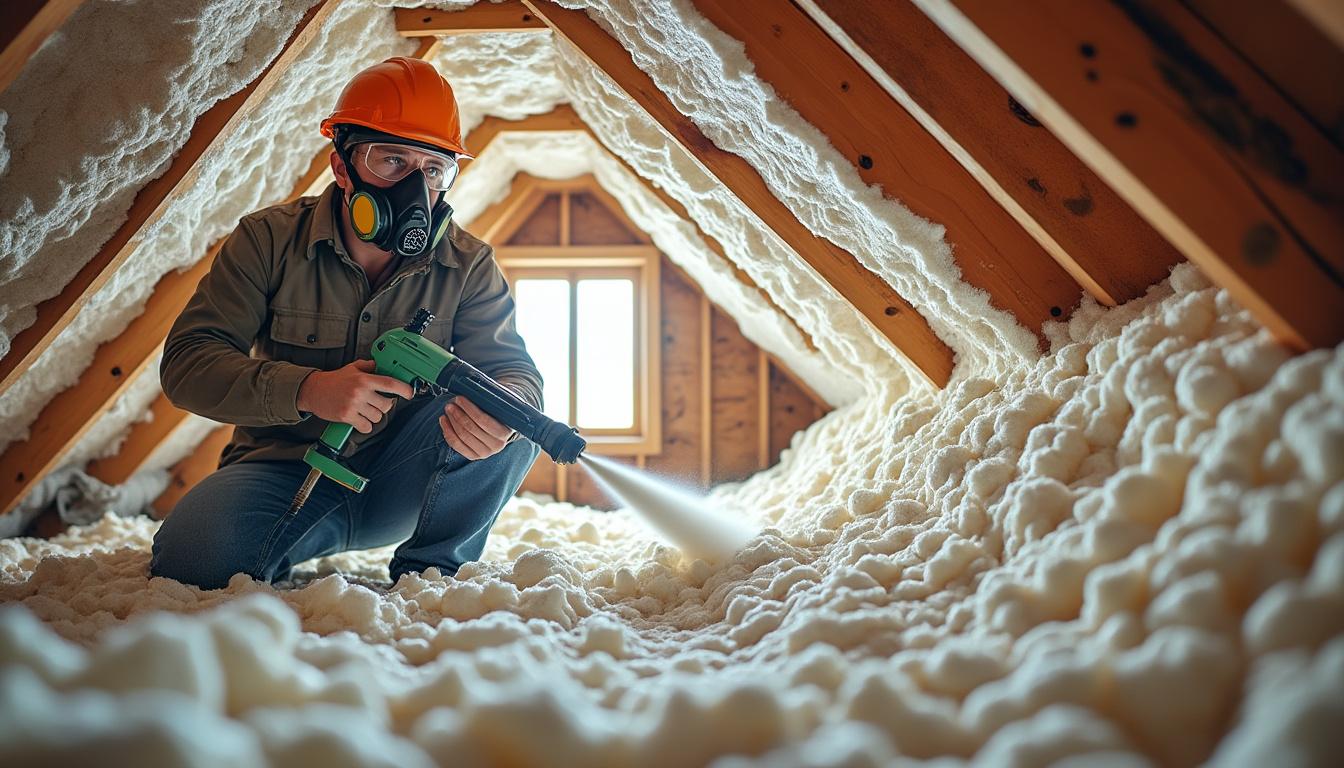
For example, insulating a 1,200 square foot attic with a 6-inch closed-cell foam layer requires:
1,200 ft² × 6 in = 7,200 board feet
This figure is crucial for pricing, as costs per board foot are multiplied by this number, along with waste allowances and other factors.
Waste and Overspray: The Invisible Cost Factors
Spray foam application is rarely perfect, and installations typically include an additional waste percentage to cover overspray, irregular framing, difficult access areas, and trimming. Waste factors commonly range from 8% to 15%, depending on foam type and site conditions:
- Open-cell foam waste usually falls between 10-15% due to its expansive nature.
- Closed-cell foam tends to have slightly lower waste, around 8-12%, because of its dense application.
Including these factors in estimations avoids surprise costs and ensures that material orders are sufficient without excessive leftovers.
Practical Application and Regional Labor Influence
The actual installation price is not solely a function of foam cost per board foot but is heavily influenced by labor rates, which differ significantly across the United States. Urban areas and coastal regions typically command 10-25% higher labor fees compared to rural Midwest and Southern states, where prices might be 5-15% lower.
Complications during installation such as tight crawl spaces, steep roof slopes, or multi-zone projects increase labor time and complexity, further raising costs. This is why using a comprehensive spray foam insulation cost calculator calibrated for your region is advisable to obtain a precise estimate.
Additionally, projects involving removal of old insulation can add $0.40 to $1.00 per square foot to the overall price. Mandatory protective coatings to meet fire safety codes commonly cost between $0.80 and $1.30 per square foot, which should be factored into the budget.
For a robust tool that accounts for these variables, including labor and regional adjustments, homeowners and contractors alike can consult professional-grade calculators such as the one featured on My Pocket Calculator’s spray foam cost estimator.
Typical Project Costs and Real-World Scenarios Demonstrating Price Variability
Spray foam insulation costs widely vary depending on the size, location, foam type, and scope of the project. Understanding national averages helps set expectations, though actual quotes will reflect local labor rates and specific project conditions.
National Price Ranges per Square Foot
| Foam Type | Low Price ($/ft²) | Average Price ($/ft²) | High Price ($/ft²) |
|---|---|---|---|
| Open-Cell Installed | $1.00 | $1.40 | $2.00 |
| Closed-Cell Installed | $2.00 | $2.90 | $4.50 |
Sample Project Estimates Using Realistic Inputs
- 1,200 ft² attic insulated with 6 inches open-cell foam: About 7,920 board feet after 10% waste. Typical installed cost roughly $10,000 to $12,000.
- 500 ft² basement rim joists insulated with 2 inches closed-cell foam: Around 1,100 board feet total. Project costs estimated between $2,300 and $3,000.
- 2,000 ft² whole house walls insulated with 3 inches closed-cell foam: Approximately 6,600 board feet including waste. Price clustering around $18,000 to $22,000.
These examples illustrate how foam type, thickness, and application area strongly dictate the budget. Tools like those on HomeGuide or Angi’s cost overview provide useful references when planning.
Energy Efficiency Benefits and Long-Term Savings That Offset Initial Investments
Beyond upfront costs, spray foam insulation offers substantial energy efficiency gains and durability that justify its price for many homeowners. Closed-cell foam’s high R-value can reduce heating and cooling load by up to 30%, leading to markedly lower utility bills. Its integrated air and vapor sealing properties prevent drafts and control moisture, minimizing the risk of mold and wood decay.
The Role of R-Value and Thermal Resistance in Cost-Effectiveness
The R-value, a measure of thermal resistance, is critical in assessing insulation performance. Closed-cell foam delivers roughly double the R-value per inch compared to open-cell, allowing the same thermal protection with thinner layers. This advantage is pivotal in renovations or constructions where cavity depths are limited.
For instance, upgrading a home’s exterior 2×4 walls with closed-cell foam (around 21-R value in 3.5 inches) can dramatically reduce heat loss compared to an uninsulated wall at approximately 4-R. This translates into saving thousands of dollars over heating seasons depending on climate. Moreover, smaller heat losses mean homeowners can opt for smaller HVAC systems, which are cheaper to install and operate.
Longevity and Property Value Impact
Spray foam insulation also boasts a lifespan of over 50 years without sagging or settling, unlike fiberglass or cellulose. This longevity ensures sustained energy savings and reduced maintenance. Additionally, homes insulated with spray foam often command higher resale values due to improved comfort, air quality, and energy performance—features modern buyers prioritize.
Maximizing Cost Efficiency
Homeowners can implement specific strategies to reduce overall spending without compromising performance. Using a hybrid approach—closed-cell foam in moisture-sensitive zones like basements combined with open-cell in other areas—balances effectiveness and cost. DIY removal of existing insulation, where safe, cuts labor expenses. Scheduling insulation work during off-peak seasons may also lead to discounts.
For those looking for deeper guidance on boosting energy efficiency with targeted foam applications, see advice at Allyear Insulation’s spray foam R-value explanations.