
Understanding the insulation value of materials is crucial when building or upgrading properties in the United States, especially in 2026 when energy efficiency standards are more stringent than ever. Among insulation options, spray foam insulation has gained attention for its superior thermal resistance and ability to enhance home comfort by regulating temperature effectively. The R value of spray foam insulation, which measures its resistance to heat transfer, is a key factor influencing decisions for homeowners, contractors, and developers seeking cost savings and optimal energy efficiency. This article delves deeply into the R value specifics of spray foam insulation, why it matters, and how it compares with other insulation materials commonly used in residential and commercial construction across the US.
In brief:
- Spray foam insulation’s R value varies widely between types, with closed-cell foam offering up to R-7 per inch and open-cell around R-3.5 to R-4 per inch.
- The insulation thickness required depends on the desired R-value for specific climate zones and building parts such as attics, floors, and walls.
- Closed-cell spray foam provides both air and vapor barriers, making it ideal for colder climates and high-moisture environments.
- Open-cell spray foam excels at soundproofing and filling complex spaces but lacks moisture barrier properties.
- Choosing the correct type and thickness of spray foam affects not just energy bills but also building code compliance and long-term structural integrity.
Detailed Insights into Spray Foam Insulation R-Value: What Homeowners Should Know
Spray foam insulation distinguishes itself in the world of building insulation by offering very high thermal resistance compared to many traditional materials. The R value represents a material’s ability to resist heat flow: the higher the R value, the better the thermal resistance. This parameter plays a direct role in temperature regulation within a building, ultimately impacting energy use and comfort levels.
There are two main types of spray foam insulation used in the American market: open-cell and closed-cell. Open-cell foam is lighter, prevents air infiltration, and has an R value of approximately 3.5 to 3.8 per inch, whereas closed-cell foam is more dense and has a much higher R value, near 6 to 7 per inch. These differences arise from their respective chemical compositions and cellular structures. For instance, closed-cell foam’s dense matrix creates tiny sealed cells that trap gas, providing enhanced insulation and acting as a vapor barrier.
Because the R-value is linked to thickness, it’s essential to calculate the proper depth of spray foam to meet local building codes or desired energy efficiency goals. For example, if an attic requires insulation up to R-21, applying about 3 inches of closed-cell foam is sufficient (since 21 ÷ 7 = 3), but open-cell foam would need to be over 6 inches thick to provide the same thermal resistance. This affects not only material cost but also installation feasibility, especially in spaces where depth is limited.
The versatility of spray foam insulation also means it can adapt to different parts of a home, such as walls, floors, and crawl spaces, contributing to better overall thermal performance. For homeowners interested in understanding more about how R-value influences the efficiency of spray foam, detailed resources available at sprayman.co offer excellent explanations and practical guidance tailored to US buildings.
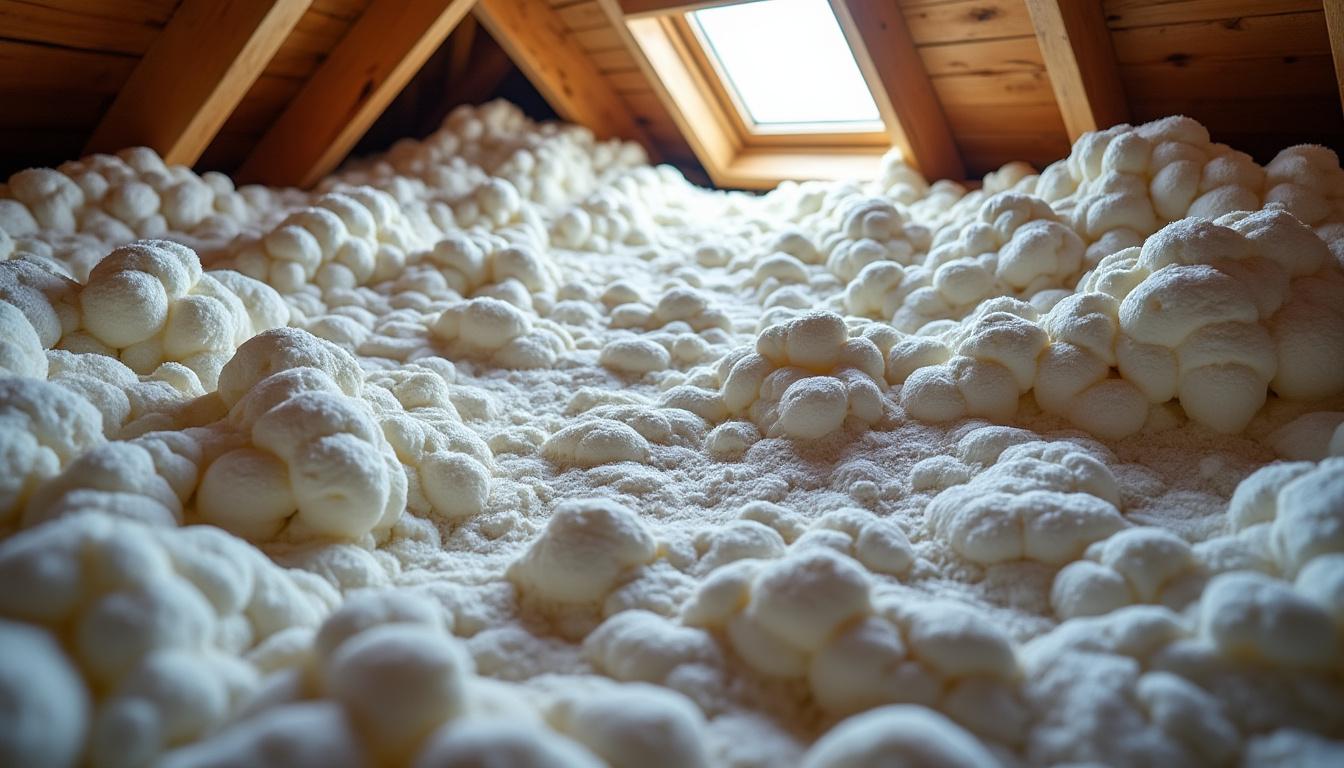
How to Determine the Right Spray Foam Insulation Thickness for Your Climate Zone
The United States is divided into seven climate zones, each with specific insulation requirements to ensure heating and cooling efficiency while maintaining indoor comfort. The required R values differ markedly, making the choice of spray foam insulation thickness essential to comply with local standards and maximize energy efficiency.
For example, in Zone 1, which includes much of the southern US, an R-30 rating is recommended for attics, whereas in the colder Zone 7, R-60 is preferred. Applying spray foam insulation in these various zones entails adjusting thickness to achieve these values. Using the inherent R-value per inch, it is possible to calculate the necessary depth for open-cell and closed-cell spray foam accurately.
| Climate Zone | For Attic (R-Value) | Open-Cell Foam Thickness (inches) | Closed-Cell Foam Thickness (inches) |
|---|---|---|---|
| Zone 1 | R-30 | 8.6 | 4.3 |
| Zone 2 | R-49 | 14.0 | 7.0 |
| Zone 3 | R-49 | 14.0 | 7.0 |
| Zone 4 | R-60 | 17.1 | 8.6 |
| Zone 5 | R-60 | 17.1 | 8.6 |
| Zone 6 | R-60 | 17.1 | 8.6 |
| Zone 7 | R-60 | 17.1 | 8.6 |
While spray foam insulation thickness may appear impractical at times (e.g., more than a foot for open-cell foam to reach R-60), these figures help contractors and homeowners evaluate feasibility. Alternatives like mineral wool or rigid foam boards might be recommended when thickness becomes an issue, especially for retrofit projects. For a deeper dive into matching spray foam thickness with R-values and installation strategies, Airflow Academy offers comprehensive guides.
Understanding your specific climate zone’s requirements is a step towards smart building insulation decisions. It not only ensures compliance with American building codes but also allows for optimized temperature regulation inside homes and offices year-round, leading to substantial utility cost savings over time.
Comparing Spray Foam Insulation R-Value with Other Popular Insulation Materials
Although spray foam insulation is revered for its high R-value per inch and airtight sealing, homeowners and contractors often wonder how it stacks up against other common materials like fiberglass, cellulose, and rigid foam panels. Each material varies significantly in both thermal resistance and installation characteristics, impacting overall project outcomes.
Fiberglass, the most widely used insulation type in the US, typically provides an R-value of roughly 3.2 to 3.8 per inch. While budget-friendly and widely available, fiberglass needs thicker layers than spray foam to achieve similar insulation. For instance, to reach an R-13 rating—a common baseline—you would require about 3.4 inches of fiberglass compared to only 2 inches of closed-cell spray foam. This difference can impact wall cavity sizes and energy performance significantly.
Cellulose is an eco-friendly option made from recycled paper, often used in attics and wall cavities. Its R-value hovers around 3.5 to 3.8 per inch, comparable with open-cell spray foam. However, cellulose lacks the moisture resistance and air sealing capabilities of closed-cell foam. Despite this, cellulose shines in cost-effectiveness and sound dampening, making it an option worth considering for certain retrofit applications.
Rigid foam boards sit somewhat between spray foam and traditional insulations by offering an R-value ranging from 3.8 to 6.5 per inch, depending on the type. While they provide excellent thermal resistance and moisture protection, rigid foam must be carefully sealed around edges to avoid air leakage, whereas spray foam naturally expands to fill gaps.
Below is a comparative table illustrating R-values in relation to thickness and common insulation materials:
| Material | Approximate R-Value per Inch | Thickness for R-13 | Price Range (Cost Efficiency) |
|---|---|---|---|
| Closed-Cell Spray Foam | 6 to 7 | 2 inches | High |
| Open-Cell Spray Foam | 3.5 to 4 | 3.5 to 4 inches | Moderate |
| Fiberglass Batts | 3.2 to 3.8 | 3.4 inches | Low |
| Cellulose | 3.5 to 3.8 | 3.5 inches | Low to Moderate |
| Rigid Foam Boards | 3.8 to 6.5 | 2 to 3.5 inches | Moderate to High |
When making a choice, it’s vital to weigh factors such as insulation performance, energy efficiency, moisture resistance, application environment, and long-term maintenance costs. For a comprehensive review of competitive materials, readers can explore articles available on Spray Foam Insulation USA, which provide additional expert comparisons and installation tips.

Practical Considerations: Installation, Cost Impact, and Long-Term Benefits of Spray Foam Insulation
Investing in spray foam insulation is often viewed as a premium choice, but its benefits extend beyond just high thermal resistance. Installation plays a critical role in ensuring the efficiency gains promised by its impressive R-value. Spray foam must be expertly applied, ideally by trained professionals, so that it adheres correctly and expands sufficiently to fill every nook and cranny, thus preventing air leaks and thermal bridging.
Cost is an important factor for homeowners and contractors. Closed-cell spray foam is generally more expensive than open-cell due to its higher density and R-value per inch. The price range in 2026 for closed-cell spray foam typically sits between $0.90 and $1.50 per board foot, while open-cell foam costs range from $0.25 to $0.50 per board foot. For a 1,100 square foot space, closed-cell installation at 3.5 inches can amount to approximately $3,400, whereas open-cell at 3.5 inches will be closer to $1,450. However, the superior compression resistance and vapor barrier qualities of closed-cell foam might justify the initial cost in colder or moisture-prone areas.
- Spray foam insulation resists moisture intrusion and therefore helps prevent mold growth.
- Its air-sealing ability reduces HVAC system strain and prolongs equipment life.
- The lifespan of spray foam insulation can reach up to 80 years without R value degradation.
- Proper application reduces drafts, contributing to considerable cost savings on energy bills.
From an environmental perspective, using spray foam effectively improves a building’s energy footprint—enhancing year-round comfort and protecting against severe weather conditions. As interest in sustainable building practices grows, the lasting impact on utility costs and home comfort solidify spray foam as a favored material.
For those curious about DIY options, spray foam kits available at retailers such as Lowe’s or Home Depot provide solutions for small-scale jobs like sealing gaps or insulating difficult-to-reach places. However, caution is advised since chemical handling requires safety gear and expertise. More guidance on selecting suitable spray foam kits can be found at All Year Insulation.