
The Xanadu Project (now American Dream) reveals that mega-developments require extraordinary site preparation strategies. You’ll face challenges like building on marshy terrain, where $100 million in specialized foundation work may be necessary. Financial stability proves crucial, as multiple bankruptcies led to a 23-year timeline instead of the planned schedule. Environmental remediation, modular construction techniques, and realistic timeline projections form the cornerstone of successful large-scale projects. The following analysis unpacks these critical lessons in detail.
Key Takeaways
- Soft tidal marsh soil required $100 million in specialized geotechnical solutions, demonstrating how challenging terrain demands extensive subsurface engineering.
- The 219-unit modular construction strategy saved 18 months of development time while enhancing precision and worker safety.
- Financial instability led to multiple bankruptcies and a $500 million funding gap, underscoring the critical importance of securing robust financing.
- Environmental challenges necessitated innovative emission reduction systems, contaminated soil remediation, and wetland impact monitoring throughout construction.
- The 23-year timeline and multiple ownership changes reveal the consequences of underestimating regulatory hurdles and environmental remediation complexities.
Conquering the Meadowlands: Unprecedented Geotechnical Challenges
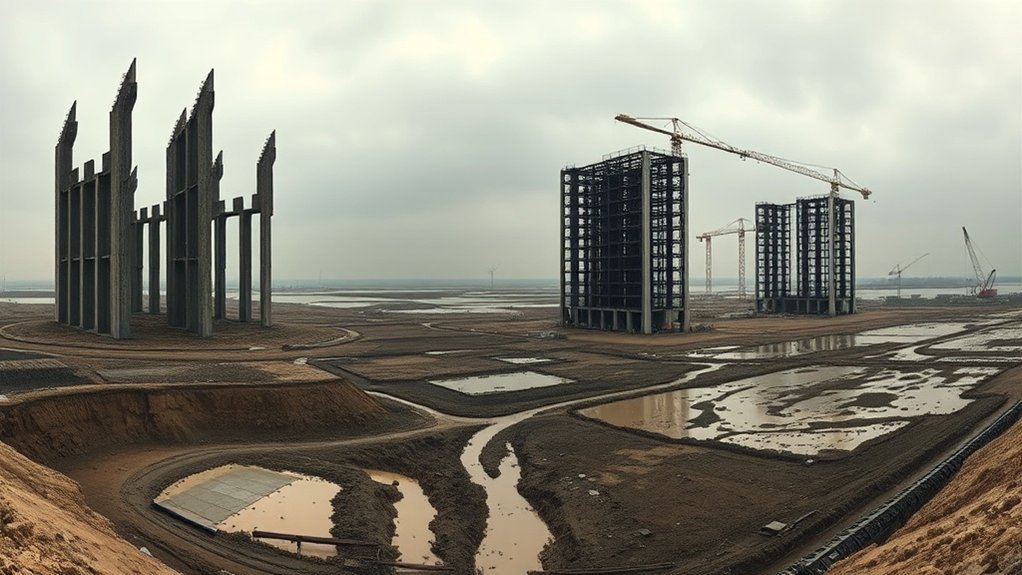
Before a single structural beam could rise at Xanadu, engineers confronted what many considered an impossible site condition: a vast tidal marsh with soil so soft that heavy equipment nearly sank upon initial testing. This required $100 million solely for subsurface work and 18 months dedicated to geotechnical design.
You’ll appreciate the complexity: tidal marsh deposits varying from 2 to 33 feet in thickness demanded sophisticated soil stabilization techniques throughout the site. Engineers implemented geotechnical innovations including complete crane matting programs integrated with building foundation systems.
What makes this challenge particularly notable is the comprehensive pile foundation requirements—necessary not just for buildings but for all infrastructure including the ring road. The project involved dealing with a variety of subsurface conditions, including fill materials, organic silt, peat, varved clay, and shale bedrock.
The brackish environment further complicated matters, accelerating corrosion risks and requiring specialized solutions for long-term structural integrity.
Modular Construction: Prefabrication as a Solution for Mega-Projects
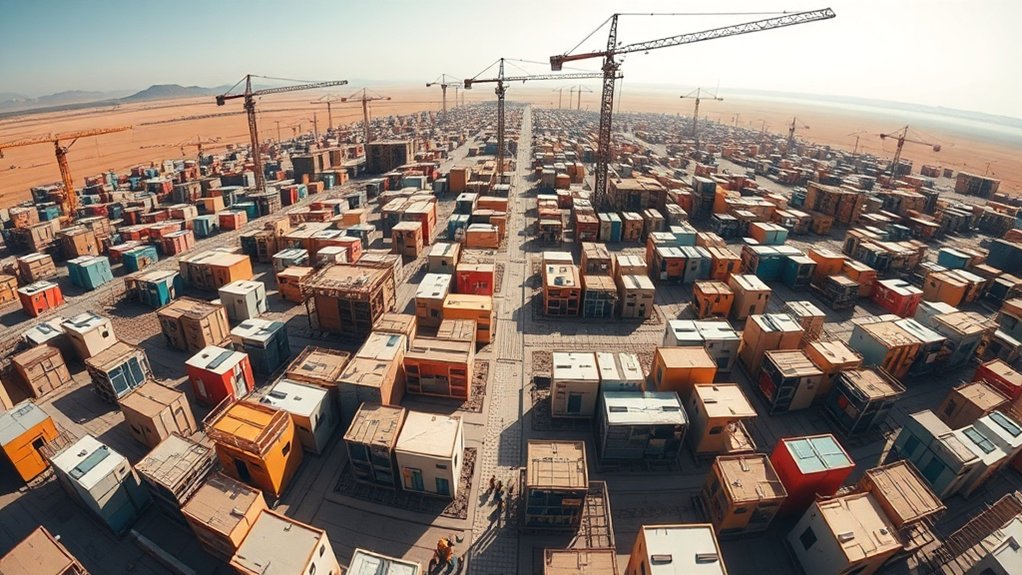
While addressing the site’s geotechnical complexities, project engineers simultaneously revolutionized construction methodology through an ambitious prefabrication strategy.
You’ll find the approach centered on 219 massive prefabricated units, each averaging 30 tons and spanning 73 feet across structural frameworks.
The modular efficiency manifested through adjacent parking lot assembly, where units received pre-installed mechanical systems before transport to final positions.
Self-propelled modular transporters achieved precise placement within 1/8 inch tolerance, reducing crane time by 35%.
Prefabrication benefits extended beyond construction logistics. QR code tracking enabled real-time quality verification and coordination between subcontractors.
This comprehensive approach shortened the timeline by 18 months while enhancing worker safety through reduced high-elevation work.
The $200 million steel fabrication investment ultimately facilitated breaking the complex project into nine manageable $300 million segments.
PCL’s construction team strategically divided the work among numerous trade firms to maintain specialized expertise across the enormous project scope.
Managing the Unmanageable: Breaking Down a $6 Billion Project
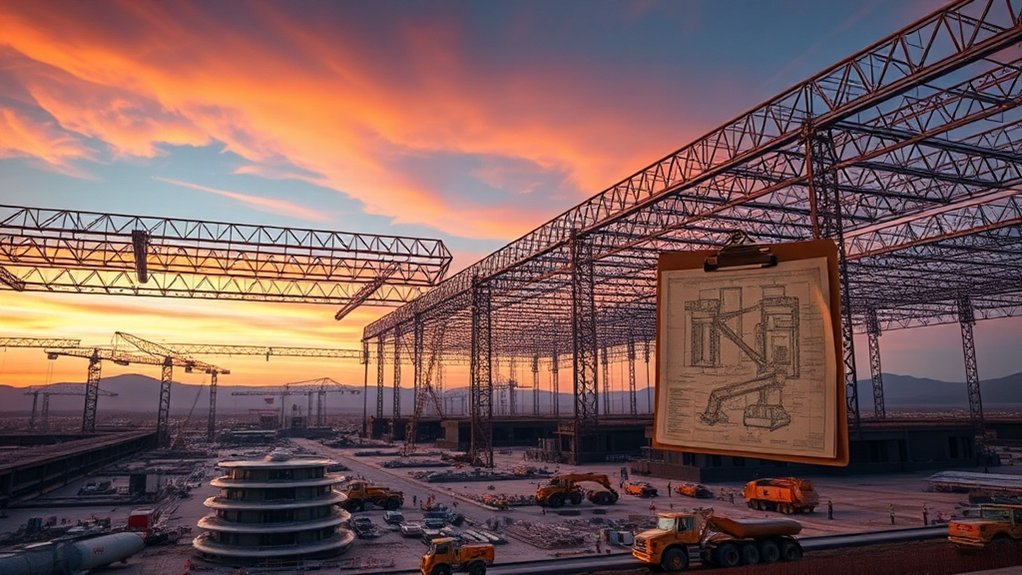
When tackling a $6 billion megaproject like Xanadu, you’ll need to partition the monumental scope into manageable work packages with clearly defined interfaces and dependencies.
You can establish specialized teams that align with the project’s unique challenges, particularly creating dedicated units for the geotechnical complexities that required $100 million in subsurface investments across marshland conditions.
This division approach lets you scale effectively, with each team applying domain-specific expertise while maintaining coordination through integrated scheduling systems that accommodate the project’s 13-year timeline and repeated stop-start cycles.
Divide and Conquer
Tackling a mammoth $6 billion development like Xanadu required strategic decomposition into manageable components with clear execution paths.
Project segmentation proved essential, with the team dividing construction into distinct operational zones: separate ETFE-domed structures for water and amusement parks, an independently-built snow dome, and a retail core sequenced separately from entertainment anchors.
This approach extended to infrastructure, where the $100 million subsurface work preceded above-ground construction, while ring roads required specialized pile foundations due to marshland conditions.
Design collaboration across teams enabled adaptability when challenges emerged—such as implementing exterior reskinning as a standalone phase after gubernatorial criticism.
Financial segmentation paralleled physical division, with subsurface work funded through separate capital allocation and contractor payments tied to specific project phases, creating clear accountability metrics despite the project’s massive scale.
Specialized Teams Scale
The sheer magnitude of the $6 billion Xanadu development demanded not only strategic project segmentation but also specialized expertise deployment at an unprecedented scale.
You can’t coordinate 150+ subcontractors and 20 consultants without precision-engineered team dynamics.
The project masterfully balanced firms with prior Xanadu experience alongside new regional contractors who brought critical marshland expertise.
When facing the waterlogged Meadowlands site, you’ll appreciate how local companies like D’Annunzio & Sons collaborated with PCL’s Florida staff, who contributed specialized poor-soil construction techniques.
This integration extended to technological resource mobilization, where at peak construction, 20 cranes operated simultaneously.
The specialized expertise wasn’t limited to construction—strategic partner coordination systems included electronic master scheduling and a single dock master overseeing all 27 loading slips through an innovative self-scheduling system.
Transportation Infrastructure: Building Roads Before Building the Destination
Before a single retail store or entertainment venue could rise from the marshy terrain, Xanadu’s development team faced the monumental task of establishing comprehensive transportation infrastructure.
You can’t appreciate the scale until you understand that $100 million went into subsurface work before roadways could even be built.
The project required extensive traffic flow management, maintaining operations during MetLife Stadium events while constructing new flyover ramps and modifying the interior road network.
Infrastructure investment priorities included $150 million for a New Jersey Transit rail spur and $395 million in regional improvements.
Engineering challenges were immense—14 acres of marshy land necessitated pile foundations even for basic roads.
Construction phases spanned years, with multiple road relocations to maintain traffic flow while accommodating 8,000+ parking spaces across development phases.
Environmental Responsibility in Massive Construction Projects
You’ll find the Xanadu project incorporated several emission reduction innovations including methane gas mitigation systems and vehicle pollution controls mandated by NJDEP’s quarterly compliance requirements.
Your sustainable resource management strategy must address the PCBs, benzyls, and metals exceeding non-residential soil cleanup criteria through specialized remediation techniques.
The development’s responsibility to maintain the « delicate environmental balance » required by N.J.S.A. 5:10-23 necessitates ongoing monitoring of wetland impacts, particularly in the Walden Swamp preservation area designated as an environmental offset.
Emission Reduction Innovations
While undertaking a project of Xanadu’s magnitude, developers implemented groundbreaking emission reduction strategies that established new environmental benchmarks for large-scale construction.
Working alongside the NJDEP, they pioneered New Jersey’s first diesel emissions monitoring program, requiring construction equipment modifications and mandatory low sulfur fuel usage. This comprehensive approach demanded quarterly compliance reports and meticulous air quality analysis throughout the project lifecycle.
Despite anticipating 110,000 daily visitors, designers addressed traffic mitigation through strategic planning to reduce automobile emissions.
The facility’s notable energy efficiency features included a heavily-insulated snow dome that consumed less energy than standard office buildings, with plans for solar integration.
The project navigated complex environmental permitting requirements including stormwater management, soil erosion controls, and pollution control measures – creating a template for construction compliance in environmentally sensitive areas.
Sustainable Resource Management
Despite its ambitious scope, the Xanadu project faced substantial scrutiny for its environmental resource management practices, with critics like Sierra Club’s Jeff Tittel labeling it « the biggest water hog in the state. »
The project’s Environmental Impact Statement revealed concerning levels of contaminants including PCBs, benzyls, and metals that exceeded NJDEP non-residential soil cleanup criteria—complications that required comprehensive mitigation strategies.
To address these ecological impact concerns, regulators mandated a water conservation plan as a condition for approval.
The proposed solution included xeriscape landscaping with drought-tolerant plants and high-efficiency drip irrigation systems for high-visibility areas.
Additionally, developers were encouraged to implement grey water utilization from building and parking lot runoff for landscape irrigation—a sustainable approach that became increasingly critical as the project struggled with viability amid environmental challenges.
The Logistics of Multiple Contractors: Coordination at Scale
Managing 150-plus trade firms on a project of Xanadu’s magnitude required sophisticated coordination systems that transcended traditional construction management approaches.
The implementation of a centralized electronic platform replaced individual dock masters across all 27 loading slips, creating unprecedented subcontractor synergy through self-scheduling capabilities for material deliveries.
This logistical efficiency extended to equipment management, where 18 simultaneous cranes—including seven tower cranes and the specialized VPC-MAX Manitowoc 650—operated on carefully engineered foundations.
The QR code tracking system for 219 modular units weighing 30 tons each enabled precise coordination throughout fabrication, inspection, and installation phases.
Weekly coordination meetings addressed interface challenges between trades, while standardized procedures ensured environmental compliance across all contractors, particularly for the diesel emissions monitoring program with the New Jersey Department of Environmental Protection.
Timeline Realities: When Projects Exceed Initial Estimations
When a development spans 23 years from conception to completion, you’re witnessing more than construction delays—you’re observing a fundamental failure of timeline estimation.
American Dream Meadowlands illustrates how project delays cascade exponentially, transforming a three-year construction timeline into a 15-year odyssey.
The progression reveals predictable inflection points: ownership transfers caused multi-year construction hiatuses, while environmental remediation requirements added unexpected phases.
Construction timelines suffered from successive setbacks—Mills Corporation’s bankruptcy, Triple Five’s financing challenges, and complex geotechnical requirements that expanded scope.
Project managers should recognize these patterns: initial timelines typically underestimate regulatory hurdles, financing complexities, and environmental remediation requirements.
Each delay compounds interest costs, complicates contractor relationships, and reshapes market conditions—turning a $300 million project into a $5 billion investment.
Innovative Structural Solutions for Entertainment Venues
Engineering entertainment venues across wetlands requires solutions as unconventional as the attractions themselves.
At Xanadu, structural innovation emerged through lightweight ETFE air-inflated domes—significantly reducing load on unstable soil while creating expansive entertainment spaces. The nation’s first indoor ski slope employed a « built like a freezer » design with exceptional insulation, operating more efficiently than standard office buildings despite maintaining snow year-round.
Wood laminate beams in arched configurations provided strength while minimizing weight—critical when building on former landfill and marsh areas.
Entertainment engineering demanded custom solutions for each venue: specialized waterproofing for indoor water parks, precise load calculations for the 300-foot Pepsi Ferris wheel, and dedicated foundation systems beneath the ring road infrastructure.
These adaptations allowed multiple venues with varying structural requirements to coexist within a single complex.
Equipment Management and Safety in Challenging Site Conditions
You’ll need specialized foundation strategies when facing the $100 million challenge of building on marshy terrain where even Bobcats risk submersion.
Your equipment management must include precise crane positioning plans that account for limited foundation load capacity and restricted movement options once placed.
Integrating local contractors with marshland expertise becomes essential for implementing safety protocols that prevent ground subsidence while maintaining continuous soil stability monitoring.
Stabilizing Swampy Foundations
The treacherous marshland conditions at the Xanadu site presented unprecedented equipment management challenges that required meticulous planning and specialized safety protocols.
With $100 million dedicated to foundation stabilization techniques, contractors implemented extensive pile-driving operations across all major structural elements.
You’ll find the soil compaction methods were strategically adapted through multi-firm collaboration, as PCL Construction leveraged Florida-based expertise alongside Langan Engineering’s geotechnical oversight.
This integration proved crucial after a Bobcat incident highlighted the site’s instability risks.
Weight reduction became paramount, leading to the selection of air-inflated ETFE domes rather than conventional roofing.
The 18-month foundation phase required 20 precisely positioned cranes with minimal repositioning capabilities due to the soft terrain, necessitating careful load calculations to prevent further ground compromise.
Equipment Flotation Solutions
More than forty specialized flotation mats were strategically deployed across the Xanadu site to distribute equipment weight and prevent sinking in the treacherous marshland conditions.
These mats proved critical for maintaining equipment stability in soft terrain where even Bobcat vehicles risked complete submersion.
You’ll find construction sequencing was dictated by initial crane positioning, as relocation wasn’t feasible once placed.
The project team engaged local contractors with specific marshland expertise to operate the twenty cranes and 135 snorkel lifts deployed during peak construction.
Weight management strategies became essential, with precise load calculations determining equipment selection and placement.
The $100 million subsurface infrastructure investment supported these heavy machines, while pile-supported ring roads facilitated movement across the site, coordinated carefully with neighboring MetLife Stadium’s event schedule.
Lessons for Future Mega-Development Projects
Analyzing Xanadu’s tumultuous journey from concept to completion reveals critical lessons for any organization undertaking mega-development projects.
Secure robust project financing before breaking ground—Xanadu’s $500 million funding gap and multiple bankruptcies demonstrate the catastrophic impact of financial instability.
You’ll need contingency reserves exceeding typical projects when building on challenging sites like marshlands, where Xanadu required $100 million in unexpected foundation work.
Prioritize early stakeholder engagement to prevent the litigation gauntlet Xanadu faced from entities like Hartz Mountain and the Sierra Club.
Their opposition created costly delays that contributed to the fourteen schedule extensions spanning thirteen years.
Implement realistic timelines that account for environmental remediation, specialized construction techniques, and potential economic downturns.
The « chronically delayed » stigma severely damaged Xanadu’s credibility—a fate you can avoid with proper planning.