
The U.S. is investing heavily in hydropower infrastructure to meet clean energy goals while maximizing existing assets. You’ll see $753 million allocated primarily for modernizing non-powered dams, which could add 12 GW of capacity and create 1.4 million jobs by 2025. Generous tax credits (Section 45Y and 48E) incentivize these projects, while pumped storage addresses grid stability needs as renewables expand. These strategic investments balance environmental considerations with America’s growing electricity demands from AI and data centers.
Key Takeaways
- Retrofitting existing non-powered dams can add 12 GW of clean electricity while creating 1.4 million jobs by 2025.
- Federal tax incentives provide substantial credits for hydropower projects, with base credits of 0.3 cents per kWh.
- Hydropower modernization delivers renewable energy without the environmental impact or regulatory challenges of new dams.
- Pumped storage hydropower provides 96% of utility-scale energy storage capacity with crucial grid stability benefits.
- Nearly half of non-federal hydropower licenses expire by 2035, risking 17 GW of capacity without renewed investment.
Meeting Clean Energy Goals Through Hydropower Expansion
As the United States accelerates its transition toward a carbon-neutral energy system, hydropower remains a cornerstone of the nation’s renewable energy portfolio, providing 6% of utility-scale electricity generation across 2,252 plants with 80.58 GW of capacity.
You’ll find significant growth potential in optimizing existing infrastructure rather than constructing new dams. Industry projections suggest the U.S. could add 60,000 MW of new capacity by 2025, with 95% coming from retrofitting non-powered dams. This approach minimizes environmental impacts while maximizing clean energy output.
The 78 non-powered dam projects currently under development will add 1.12 GW of carbon-free electricity. Recent federal support through tax incentive extensions until 2033 under the One Big Beautiful Bill Act further strengthens the economic case for these developments.
These projects, alongside modernization efforts that contributed 1.6 GW between 2010-2022, demonstrate how hydropower expansion can help meet clean energy goals without sacrificing environmental considerations.
Tax Credits and Financial Incentives Driving Infrastructure Investment
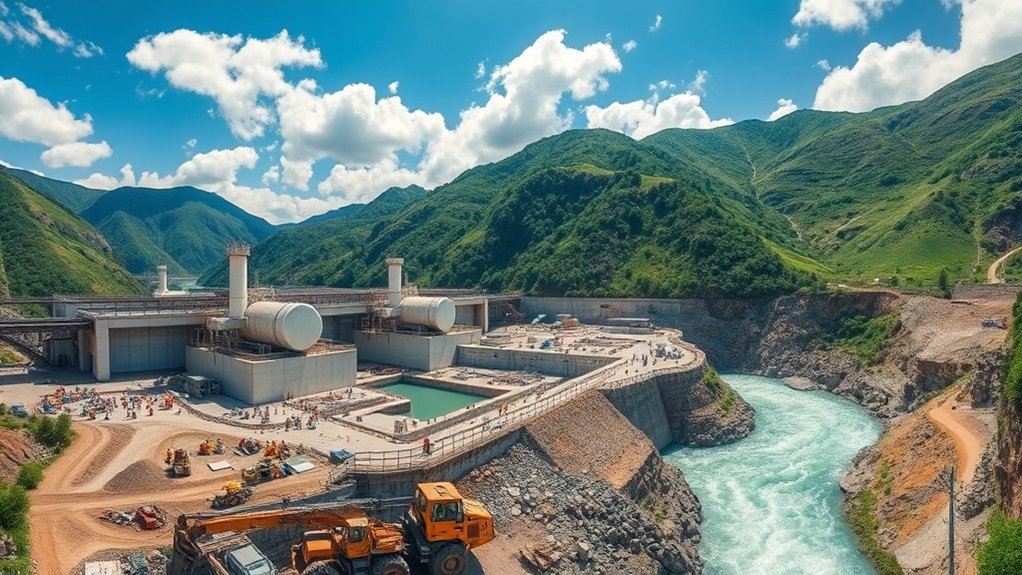
Three major tax credit provisions now drive unprecedented investment in hydropower infrastructure across the United States. The OBBBA preserves both Section 45Y production and 48E investment tax credits, explicitly recognizing hydropower as a critical baseload energy source alongside nuclear and geothermal.
Your tax credit strategies can maximize benefits through several financial incentives. Projects beginning construction before 2033 qualify for 100% credit value, with base credits of 0.3 cents per kWh that can increase fivefold when meeting prevailing wage requirements.
You’ll find additional 10% bonuses for domestic content usage and energy community locations. With the retention of the Modified Accelerated Cost Recovery System, investors can now depreciate hydropower assets over a 5-year timeframe, allowing for faster utilization of tax credits.
The legislation’s expanded elective payment provisions benefit public utilities, while the Master Limited Partnership designation creates new capital-raising pathways. These mechanisms eliminate previous restrictions, allowing both tax-exempt entities and investors without tax liability to participate in hydropower development.
Modernizing Existing Facilities vs. Developing New Projects
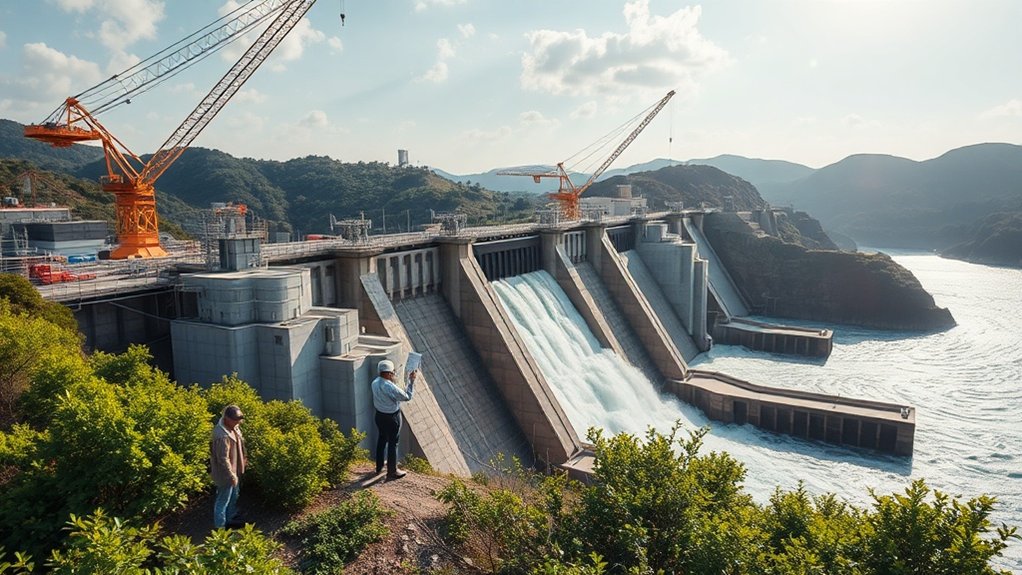
While the tax incentives outlined previously have fueled hydropower expansion broadly, industry trends reveal a clear strategic divergence between modernizing existing facilities and constructing entirely new projects.
Data shows 394MW of near-term capacity additions come from turbine-generator upgrades rather than new installations, highlighting the industry’s preference for facility upgrades over greenfield development.
This approach makes economic sense: modernization provides clean energy without the environmental footprint or regulatory hurdles of new construction.
The $753 million allocated specifically for hydropower incentives prioritizes efficiency improvements to existing infrastructure.
Meanwhile, new project sustainability challenges are evident in developments like Site C, where costs doubled despite clean energy commitments.
The contrast is stark: modernization addresses both performance and environmental concerns simultaneously, while new construction—particularly for the 70 planned PSH projects—faces higher barriers to implementation.
Pumped Storage as Grid Stability Solution for Renewable Integration
Pumped storage hydropower (PSH) represents the backbone of America’s grid stability infrastructure as renewable energy sources expand across the nation. Comprising 96% of U.S. utility-scale energy storage capacity, these « water batteries » address fundamental renewable integration challenges through multiple mechanisms.
You’ll find PSH’s value in its technical versatility—providing black start capability, delivering frequency response within seconds, and maintaining grid inertia during sudden load changes.
With round-trip efficiencies exceeding 80% and response times comparable to conventional generators, PSH offers significant pumped storage advantages for balancing volatile renewable generation.
The technology excels at storing surplus solar and wind during off-peak hours for peak demand dispatch.
Economic Benefits of Non-Powered Dam Conversions
Converting America’s 80,000+ non-powered dams could generate over 12 GW of clean electricity while creating up to 1.4 million cumulative jobs by 2025.
You’ll find these infrastructure upgrades deliver substantial economic benefits at lower costs than new construction, with analysis showing projected capacity additions of 330 MW across multiple states including significant increases in Kentucky (32%), Pennsylvania (12%), and Louisiana (20%).
Beyond direct electricity generation, these projects offer quantifiable non-market value through enhanced recreational opportunities worth tens to hundreds of thousands of dollars annually per project.
Untapped Revenue Potential
Although only 3% of America’s approximately 80,000 dams currently generate electricity, the economic potential from converting non-powered dams represents a massive opportunity for the U.S. energy sector.
Studies from the Department of Energy and Oak Ridge National Laboratory confirm this untapped capacity could add 12 gigawatts to the national grid.
You’ll find the economics particularly compelling: these projects require lower capital investment since many construction costs are already incurred.
States are recognizing these revenue streams – Pennsylvania will gain 121.3 MW (12% increase), Louisiana 48.6 MW (20% increase), and Iowa 36 MW (22% increase).
The Ohio River conversions alone will add 554 MW across multiple states.
Beyond direct electricity sales, these projects generate additional value through enhanced recreational opportunities and broader community development impacts.
Jobs Through Infrastructure Upgrades
The economic impact of hydropower infrastructure extends far beyond energy production, with job creation representing one of its most significant benefits.
Converting non-powered dams could generate substantial employment—the Navigant study projects 1.4 million cumulative jobs by 2025 from installing 60,000 MW of hydropower capacity.
These infrastructure upgrades create regional opportunities across the U.S. You’ll find evidence in projects like Smithland Locks and Dam, which employs 400 construction workers and will establish 7-9 permanent positions.
Current development pipelines could add roughly 300 conventional hydropower jobs and 8,787 pumped storage positions.
Despite job sustainability benefits, workforce challenges persist. The sector faces an 11.7% workforce decrease since 2019, with 92% of employers reporting difficulty hiring skilled craftspeople—precisely the workers hydropower development needs most.
Rising Electricity Demand From Data Centers and AI Technologies
Power demands from data centers across the United States are increasing at an unprecedented rate, creating significant implications for hydropower infrastructure development.
You’re witnessing a dramatic trajectory: U.S. data centers consumed 183 TWh in 2024 (4% of national electricity use), with projections showing a 133% increase to 426 TWh by 2030.
This data center growth is particularly driven by AI consumption, which currently represents 5-15% of data center power but could reach 35-50% by 2030.
AI-optimized servers demand two to four times more power than traditional servers.
Regional impacts are already severe, with data centers consuming 26% of Virginia’s electricity and double-digit percentages in several other states.
This concentrated demand creates targeted pressure points requiring strategic hydropower expansion.
Protecting Critical Assets Through Relicensing and Upgrades
You’re witnessing a critical period where 40% of America’s non-federal hydropower fleet faces relicensing amid serious economic pressures that have already caused 68 facilities to surrender their licenses over the past decade.
The financial viability of these aging assets—most approaching 80 years of operational age—depends heavily on federal incentives like the 30% investment tax credits proposed in recent legislation.
Without such support mechanisms, smaller hydropower facilities risk becoming economically unfeasible for relicensing, potentially sacrificing critical infrastructure that provides 27% of renewable electricity generation and essential black start capabilities during grid emergencies.
License Renewal Challenges
Hydropower’s future in America faces a critical junction as nearly half of the non-federal hydropower fleet will see their licenses expire by 2035, putting 17 GW of clean energy capacity at risk.
You’ll need to navigate a complex relicensing process that takes approximately 5 years from start to finish, with final applications due no later than 2 years before expiration.
Relicensing delays often stem from environmental assessments, interagency conflicts, and stakeholder consultations.
Since 2005, FERC’s Integrated Licensing Process has become mandatory, though facilities face mounting challenges as the number of projects requiring renewal is projected to double between 2020 and 2030.
The process for existing facilities typically takes 2.5 years longer than new projects due to greater environmental complexity, highlighting the urgent need for streamlining efforts like the Community and Hydropower Improvement Act.
Aging Infrastructure Economics
The economic reality facing America’s aging hydropower infrastructure presents a crucial investment challenge with substantial national implications.
You’re looking at assets that provide remarkable value—22,000 megawatts powering ten million households at just 2-4 cents per kilowatt hour—while contributing billions to the national economy.
Your infrastructure longevity concerns have clear solutions: modernization investments yield reduced material costs, decreased environmental mitigation expenses, and enhanced grid reliability benefits.
These upgrades extend the 50-100 year infrastructure lifespan while supporting 1.4 million potential jobs through expansion initiatives.
Effective maintenance strategies transform aging dams into contemporary assets that provide irreplaceable grid stability services, particularly as renewable integration increases.
With existing facilities delivering one-fourth of America’s hydropower at favorable operating costs, protecting these critical assets represents both economic wisdom and energy security.
Balancing Environmental Concerns With Energy Production Needs
While navigating the complex interplay between environmental protection and energy production, hydropower developers face significant regulatory hurdles that shape the industry’s trajectory. Comprehensive environmental assessments required during federal permitting have pushed the sector toward more sustainable practices, with 72% of proposed additions now involving non-powered dam conversions rather than new constructions.
You’ll notice the strategic shift toward smaller projects under 30MW and modernization of existing infrastructure. This approach delivers capacity increases with minimal ecological disruption.
The $34.5 million in federal grants for PG&E’s upgrades exemplifies this trend, while policies like the OBBBA extend tax credits through 2033, incentivizing environmentally-sound investments.
Even dam removals, like at the John C. Boyle Plant, represent calculated trade-offs between immediate generation capacity and long-term ecosystem restoration.