
Fiterman Hall embodies New York’s construction resilience, rising from 9/11 devastation when WTC Building 7’s collapse rendered it uninhabitable. You’ll find a marvel of engineering that transformed a contaminated site into a LEED-certified educational facility with dual-story atriums and specialized learning spaces. Its $325 million reconstruction overcame urban constraints, toxic remediation challenges, and complex logistics to serve 25,000 BMCC students. This glass-and-brick façade stands as both functional campus and powerful symbol of renewal.
Key Takeaways
- Fiterman Hall’s reconstruction following 9/11 damage represents Lower Manhattan’s resilience, transforming from ruins to a state-of-the-art educational facility.
- Complex demolition and remediation of toxic contaminants demonstrated innovative construction solutions in challenging post-disaster conditions.
- The $325 million project overcame severe urban constraints, including limited staging areas and complex logistics in dense downtown Manhattan.
- Engineers integrated 50 additional caissons while navigating existing subway infrastructure, showcasing technical ingenuity in rebuilding.
- The distinctive glass-and-brick façade by Pei Cobb Freed & Partners symbolizes cultural resilience while tripling student capacity to 25,000.
From Office Building to Educational Institution: The Pre-9/11 Story
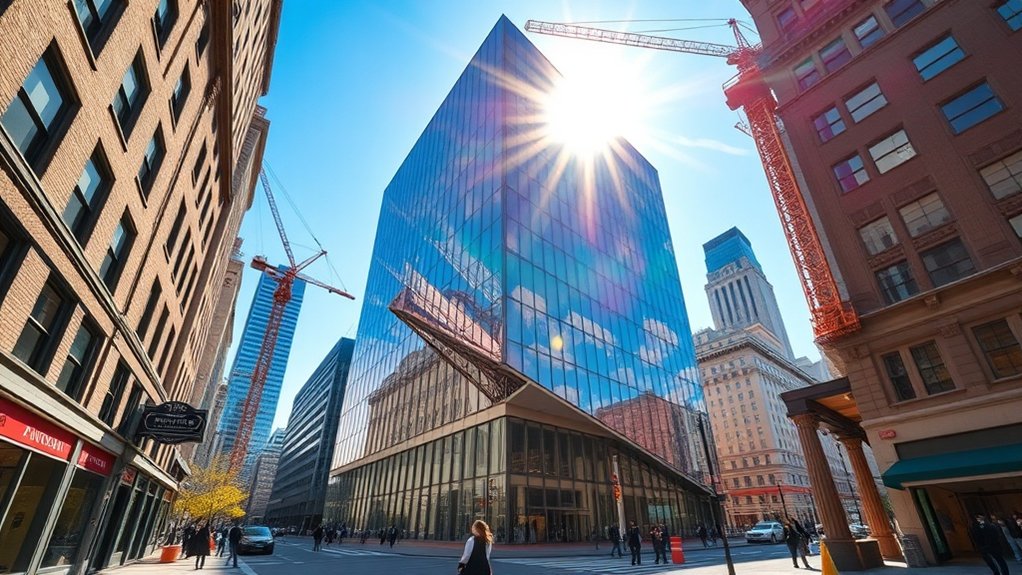
While many educational facilities are purpose-built, Fiterman Hall began its life as a conventional 16-floor office building constructed in 1959 at 30 West Broadway. The structure occupied a full city block north of the future World Trade Center site, featuring standard mid-century office design without educational considerations. The building was located in the vicinity of what was historically Radio Row, an area known for its electronics stores before the development of the original World Trade Center complex.
Businessman Miles Fiterman purchased the property in 1978, operating it as commercial space until 1993, when he and his wife Shirley donated it to BMCC. This transition required substantial modifications to transform office layouts into pedagogical environments.
In 2000, a $275 million renovation project commenced, focused on reconfiguring the building to educational standards. This educational transition demanded specialized classroom infrastructure, compliance with different building codes, and technological upgrades—a transformation that was weeks from completion when 9/11 occurred.
The Devastating Impact of September 11 and Its Aftermath
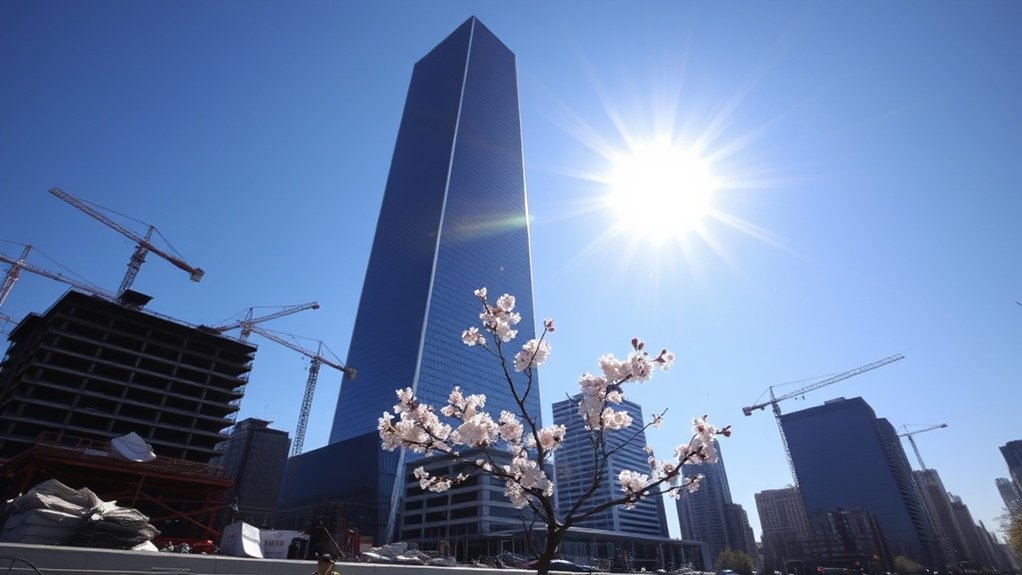
When the World Trade Center’s Building 7 collapsed at 5:20 PM on September 11, 2001, it delivered a catastrophic blow to Fiterman Hall directly across the street.
Seven stories of debris compromised the building’s structural integrity beyond repair, rendering it immediately uninhabitable.
You couldn’t simply repair the damage—the structure was permeated with asbestos, lead, dioxin, and other toxic contaminants from the collapse.
This environmental crisis complicated remediation efforts significantly.
The financial implications were equally severe, with BMCC losing a third of its classroom space while insurance disputes delayed progress.
CUNY ultimately received a $90 million settlement from FM Global in 2004 after prolonged negotiations regarding the building’s fate.
These challenges offered profound resilience lessons for future disaster response.
The eleven-year journey from destruction to rebuilding became an exercise in community healing, as the institution that lost the only college building to terrorism worked to restore educational infrastructure while enrollment continued growing.
Navigating Demolition and Rebuilding Complexities
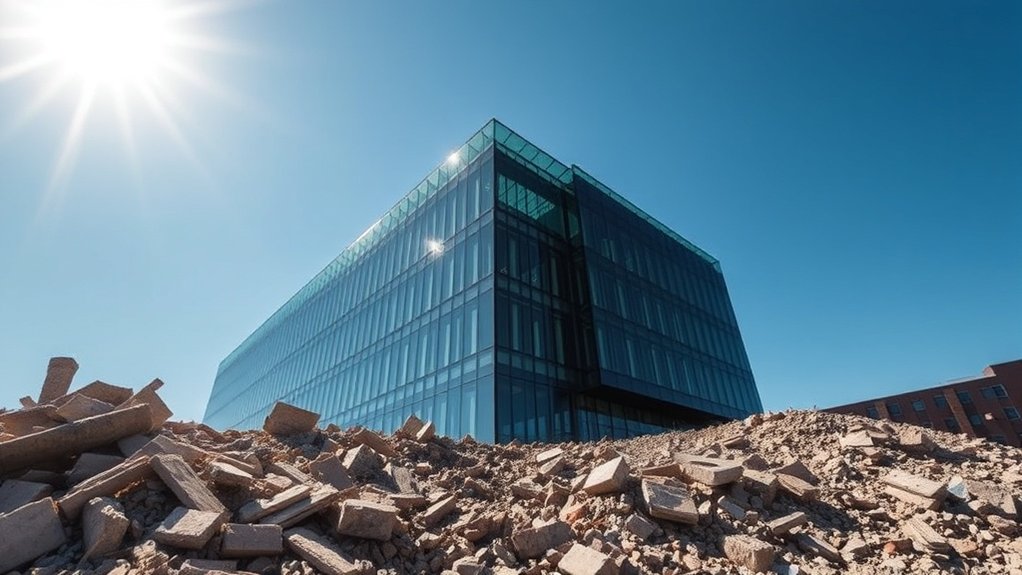
You’ll find the damaged Fiterman Hall’s demolition required specialized toxic material protocols to handle asbestos, lead, and dioxin contamination from 9/11 debris before reconstruction could begin.
The triangular site’s position adjacent to the World Trade Center memorial footprint imposed strict security protocols and logistical challenges that complicated the 14-story vertical campus design.
Structural engineers confronted foundation reuse questions while integrating the building into Lower Manhattan’s redevelopment plans, necessitating careful coordination with nearby transit infrastructure and public space requirements.
Toxic Abatement Challenges
Following the catastrophic impact of 9/11 debris, Fiterman Hall faced unprecedented toxic contamination challenges that transformed a standard rebuilding project into a complex hazardous materials operation.
The building contained a lethal cocktail of asbestos, lead, dioxin, PCBs, mercury, and PAHs that demanded specialized toxic exposure protocols far beyond typical construction parameters.
Environmental regulations imposed rigorous oversight, requiring HAZWOPER certification for workers and continuous TSP monitoring during remediation.
What particularly complicated the eight-year timeline was contractors’ inexperience with hazardous abatement coupled with OSAunion’s identification of « inadequate and flawed » demolition planning.
The financial impact was staggering—costs ballooned from an initial $90 million insurance settlement to $325 million as abatement complexities mounted.
Each demolition phase required specialized permits addressing chemical interactions between contaminants like asbestos and adhesives.
Urban Site Constraints
The dense urban landscape of Lower Manhattan compounded the already formidable toxic abatement challenges at Fiterman Hall, introducing a matrix of site constraints that shaped every demolition and reconstruction decision.
You’ll appreciate how the building’s location—just one block from the World Trade Center site—severely limited urban access options. The construction team orchestrated material logistics for 4,400 tons of steel and a 1,500-ton chiller plant through narrow streets while monitoring vibrations in adjacent structures.
Limited staging areas necessitated vertical sequencing strategies, while underground utility infrastructure demanded complex relocation coordination.
The project team transformed these constraints into a framework for implementation, establishing quarantine zones that allowed construction to proceed while the college maintained operations for its expanding student population of 24,000—triple its pre-9/11 enrollment.
Foundation Reuse Engineering
While confronting the daunting prospect of rebuilding Fiterman Hall, engineers faced critical decisions regarding the existing foundations that would ultimately determine the project’s feasibility and timeline.
You’ll appreciate how the team conducted comprehensive foundation analysis using sophisticated 3D finite-element modeling to assess load-carrying capacity and load-displacement behavior. This evaluation was crucial for determining whether the foundations could support the new structure’s requirements.
Engineers employed geophysical testing methods, including ground-penetrating radar and core sampling, to verify the structural integrity of foundation elements before certification.
Architectural Excellence Meets Educational Functionality
Fiterman Hall’s vertical campus design brilliantly resolves site constraints through dual-story atriums and interconnecting spiral staircases that create visual flow between its 15 program levels.
You’ll notice how academic « packages » organized around central communal spaces foster collaborative learning environments while maintaining specialized facilities like soundproof music rooms and computer laboratories.
The building’s high-performance curtain wall system and LEED-certified features demonstrate how sustainable building solutions can complement educational functionality without sacrificing the architectural excellence evident in its award-winning design.
Design Merges Form, Function
As embodied in its « Vertical Campus » concept, Fiterman Hall’s architectural brilliance lies in how it efficiently organizes educational programs within a 14-story, 390,000-square-foot urban footprint.
You’ll find academic programs arranged in two-floor clusters with interconnecting atriums, tripling student capacity to 25,000 while maintaining a compact site presence.
The building’s form integration is evident in its dual entrance strategy: a northwest corner connecting to campus and a southern entry facing the World Trade Center Memorial Park.
Pei Cobb Freed’s design reinterprets the traditional red brick schoolhouse for a modern business district through functional aesthetics.
The distinctive brick-faced precast panels combined with Wausau’s 71,000-square-foot glass curtainwall system creates transparency, allowing public visibility of interior spiral staircases—dramatic visual elements that illuminate the street at night.
Spaces Foster Learning Environment
The heart of Fiterman Hall’s architectural triumph lies in its thoughtfully engineered spaces that seamlessly merge educational functionality with design excellence.
You’ll find the building’s signature north and south glass atria connecting 14 floors of academic programming, creating visual transparency that enhances wayfinding while providing stunning city views.
The innovative vertical campus design efficiently organizes 54 general classrooms, 31 computer labs, and specialized learning environments including 12 soundproof music rooms and 13 art studios.
Collaborative spaces abound with 20 conference rooms and student lounges integrated within the atrium design, encouraging spontaneous interaction.
The building’s stacked atrium spaces with spiral staircases not only optimize the limited urban footprint but transform circulation into opportunities for informal learning, supporting a campus that accommodates nearly 25,000 students.
Sustainable Building Solutions
Integrating sustainability into every facet of its design, Fiterman Hall demonstrates how architectural excellence can amplify educational functionality through environmentally conscious solutions.
The structure boasts certification standards comparable to LEED while exceeding typical energy performance metrics for educational facilities.
You’ll find green materials throughout its steel-framed, brick-clad envelope, where high-performance curtainwall systems maximize natural light while maintaining thermal efficiency.
The building’s 1,500-ton chiller plant works alongside advanced energy recovery systems to reduce its operational carbon footprint.
This 390,000-square-foot vertical campus achieves energy efficiency through strategically engineered mechanical systems designed by Jaros Baum & Bolles.
The result is a facility that accommodates 24,500 students while minimizing environmental impact—earning Fiterman Hall the American School & University 2013 Outstanding Design award.
Engineering Innovations and Sustainable Design Solutions
While addressing the complex remediation challenges posed by 9/11 contamination, engineers implemented groundbreaking solutions throughout Fiterman Hall’s reconstruction that transformed technical obstacles into sustainability opportunities.
You’ll find engineering advancements in the foundation system, which ingeniously integrates 50 additional caissons with the existing foundation while accounting for nearby subway infrastructure.
The 4,400-ton steel framework supports a dual-atrium design that maximizes vertical space utilization. Sustainable practices shine through the high-performance 71,000-square-foot curtainwall system featuring polyamide thermal breaks and factory-controlled fabrication in a LEED Silver facility.
The building’s energy infrastructure includes a sophisticated 1,500-ton chiller plant with triple redundancy. These systems collectively create 390,000 square feet of energy-optimized learning space while meeting New York State’s stringent sustainability criteria.
A Phoenix Rising: The Symbolic Importance Beyond Education
Rising from literal ashes, Fiterman Hall embodies far more than educational infrastructure—it stands as a deliberate monument to Lower Manhattan’s resilience after the September 11th attacks.
When the original structure fell to debris from 7 World Trade Center, its rebuilding trajectory paralleled the neighborhood’s broader recovery narrative.
You’ll recognize in its distinctive glass-and-brick façade by Pei Cobb Freed & Partners an architectural statement of cultural resilience.
The $325 million investment represents CUNY’s unwavering commitment to community renewal despite environmental and funding challenges.
The preservation of the Fitermans’ legacy connects contemporary students with centuries of educational heritage at this site—from King’s College to today’s vibrant academic center.
This red brick beacon communicates hope across generations while maintaining strategic continuity in downtown’s transformed landscape.