
The world’s largest aquarium, Chimelong Spaceship, holds 75.3 million liters across 38 exhibits, featuring a record-breaking 39.6 × 8.3 meter viewing window. Its construction required reinforced concrete foundations, 65cm-thick acrylic panels, and seismic protection systems. You’ll find complex water management processing 11 million gallons daily with 98% recycling efficiency. Engineering innovations support diverse marine biomes while maintaining precise environmental conditions. The scale of this achievement reveals fascinating technical challenges worth exploring.
Key Takeaways
- Chimelong Spaceship holds the record with 75,350,969 liters across 38 exhibits, featuring the world’s largest viewing window at 39.6 by 8.3 meters.
- Construction required specialized foundations with 459,000 cubic feet of concrete and 65-centimeter-thick acrylic panels to manage massive water pressure.
- Seismic protection incorporates triple standard rebar density and a continuous 220-foot ring beam to enhance structural stability against earthquakes.
- Advanced water management systems process 11 million gallons daily with 98% closed-loop recycling, maintaining precise temperatures from 52°F to 82°F.
- Moving construction components required extraordinary logistics, including police-escorted convoys for 22-ton acrylic panels and specialized temporary roads.
Breaking Records: The Scale of Chimelong Spaceship
While many aquariums claim impressive dimensions, Chimelong Spaceship establishes new paradigms for aquatic facilities with its unprecedented scale.
You’ll find a staggering combined tank volume of 75,350,969 liters across 38 aquarium exhibits, with the primary tank alone holding 56,450,136 liters. Among these exhibits is the largest living reef exhibit, containing 2,848,562 liters of water and showcasing hundreds of coral species.
The facility’s record-breaking scale extends beyond water volume to its physical footprint—397,064 square meters of enclosed space, exceeding the previous indoor theme park record holder by 244,064 square meters.
The aquarium dimensions include the world’s largest viewing window: a single acrylic panel measuring 39.6 by 8.3 meters.
Chimelong’s aquatic ecosystem supports over 300 marine species, including whale sharks and manta rays, all contained within a distinctive two-story spaceship-shaped structure designed to withstand massive water pressure loads.
Historical Evolution of Mega-Aquariums
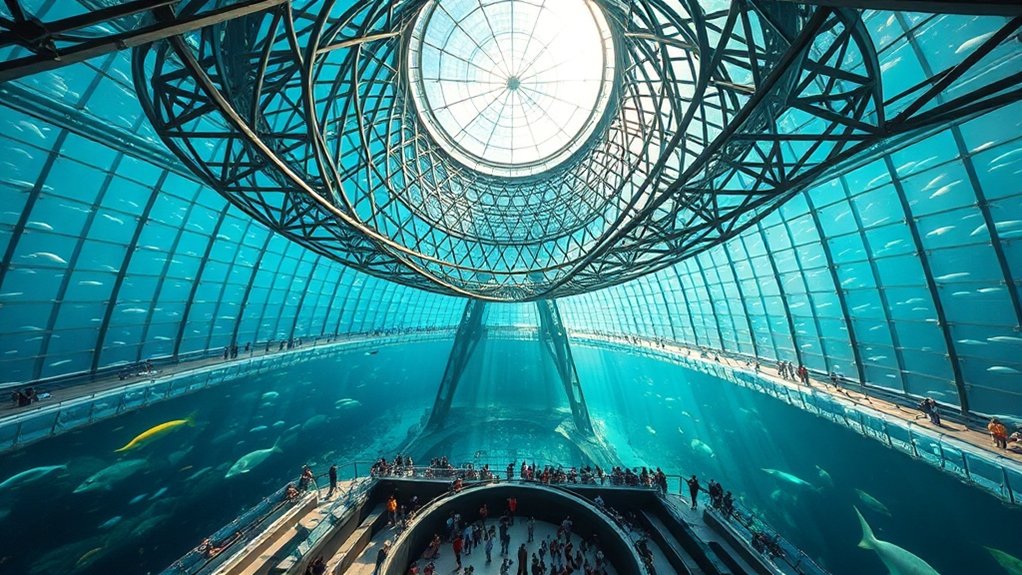
The evolution of public aquariums has transformed from small facilities like the 1904 Waikiki Aquarium with just 35 exhibits into massive complexes exemplified by Georgia Aquarium’s 8 million gallon capacity when it opened in 2005.
You’ll notice the acceleration of size expansion beginning in the 2000s, when the « mega-aquarium race » commenced with substantial financial investments like Bernard Marcus’s $250 million donation.
These engineering achievements continued through the 2010s with facilities in Singapore and China surpassing previous records, establishing a pattern of international competition driving technological innovations in life support systems and exhibit design. The Georgia Aquarium originally opened with 11 million gallons of water across its various habitats, making it debt-free at launch due to substantial corporate contributions beyond Marcus’s initial donation.
Size Growth Through Decades
Five major developmental phases mark the evolutionary trajectory of aquarium size from the 19th century to present day.
Initial glass designs by Villepreux-Power (1832) and Thynne’s balanced marine systems (1846) established foundational parameters. Size milestones accelerated post-WWI when electrical systems enabled larger installations, culminating in Shedd’s pioneering inland saltwater facility (1930).
Mid-century expansion featured New England Aquarium’s ambitious Giant Ocean Tank (1970), demonstrating aquarium innovations in large-scale marine habitats.
The late 20th century witnessed exponential growth with Sydney’s facility (1988) briefly holding the « world’s largest » title.
True mega-scaling emerged post-2000, with Georgia Aquarium’s unprecedented 8-million-gallon capacity (2005) establishing new engineering benchmarks, until Chimelong Ocean Kingdom’s 12.9-million-gallon facility (2014) demonstrated how dramatically aquarium dimensions had evolved in less than two centuries.
Notable Record-Breaking Achievements
Tracing the historical evolution of mega-aquariums reveals unprecedented engineering achievements that have consistently redefined the boundaries of aquatic habitat construction.
The current record holder, Chimelong Spaceship, exemplifies these engineering marvels with its staggering 75.3 million liter capacity certified in 2023.
You’ll find the most impressive aquarium innovations in viewing panel technology, where the Cube Oceanarium’s 40-meter by 8.3-meter acrylic window demonstrates remarkable material science breakthroughs.
Similarly, Chimelong Ocean Kingdom’s 330m² panel and Georgia Aquarium’s 75cm-thick viewing wall represent significant structural achievements.
These facilities incorporate sophisticated habitat management systems that process their entire water volume every six hours while maintaining precise water chemistry.
Multi-stage filtration and wave simulation technologies create authentic marine environments within these concrete and steel behemoths designed to withstand the pressure of 75,000 tons of water.
Structural Engineering Challenges for Massive Water Containment
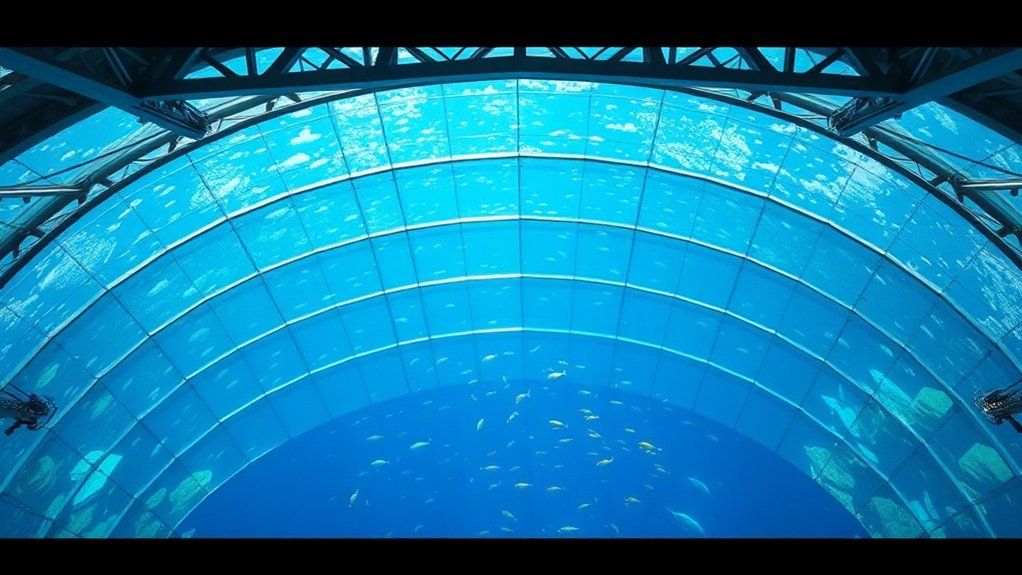
The engineering complexity of mega-aquariums demands reinforced concrete foundation systems that counteract both immense static loads and dynamic forces from millions of gallons of water.
You’ll find pressure management technologies incorporating 65-centimeter-thick acrylic panels and specialized concrete formulations that must maintain watertight integrity while resisting salt degradation.
Seismic protection designs integrate lateral force resistance systems throughout the structure, with safety factors of 11-12 to prevent catastrophic failures during earthquakes in vulnerable coastal locations.
Reinforced Concrete Foundation Systems
Constructing the world’s largest aquariums demands extraordinary reinforced concrete foundation systems that far exceed conventional building parameters.
These foundations require massive volumes—up to 459,000 cubic feet of concrete—and exceptional dimensions including 9-meter-tall bases and 3-foot-thick slabs.
Foundation innovations incorporate self-consolidating mixtures like AGILIA that flow through densely congested reinforcement networks and around precision-placed pipe systems.
Material advancements feature superplasticizers delivering strengths exceeding 8000 psi—33% above standard specifications—while corrosion inhibitors such as DCI-S ensure longevity in saltwater environments.
You’ll find these structures engineered with synthetic macro fiber reinforcements like STRUX 90/40 that eliminate corrosion risks while maintaining structural integrity.
Foundations must withstand immense water pressure while supporting viewing walls up to 1.2 meters thick, requiring excavations equivalent to four Olympic swimming pools.
Pressure Management Technologies
Managing extreme hydrostatic forces in the world’s largest aquariums requires sophisticated pressure management technologies that operate within precise tolerances.
You’ll find pressure sensing systems utilizing titanium and Hastelloy-C sensors with ceramic diaphragms that transmit 4-20 mA or S3L signals to monitor critical differential pressures across filtration systems.
The fluid dynamics within these massive volumes are controlled through hydraulic balancing mechanisms incorporating VLT® AQUA Drive FC 202 units that adjust pump power based on pressure differentials.
Sealless magnetic drive pumps constructed from PVDF and thermoplastic housings eliminate potential leak points while resisting saltwater corrosion.
Redundancy is engineered throughout, with dual AS-N oxygen generators maintaining consistent ozone feed pressure and multiple monitoring points validating system integrity.
Wet-tap assemblies allow for maintenance without interrupting water circulation—critical for maintaining habitat stability.
Seismic Protection Designs
When designing the world’s largest aquariums, engineers must confront extraordinary seismic challenges that threaten millions of gallons of contained water during earthquake events.
You’ll find ingenious seismic isolation strategies implemented through mezzanine floor joints that create crucial buffer zones between tank structures and main buildings. This approach allows for up to 50% reduction in wall thickness while maintaining structural resilience.
The primary tanks incorporate six reinforcement patterns with triple the standard rebar density, while a continuous 220-foot ring beam enhances rigidity against lateral forces.
Engineers design these massive concrete structures as inside-out systems where the 41-foot tank walls function as the primary lateral support mechanism.
The dynamic load calculations account for water dynamics during earthquakes, incorporating sloshing effects that amplify pressure against tank flexibility. This comprehensive earthquake mitigation strategy ensures integrity during seismic events.
Acrylic Technology: Manufacturing and Installing Giant Viewing Panels
The engineering marvel of modern aquariums hinges on revolutionary acrylic technology that enables the creation of massive transparent viewing panels. The acrylic manufacturing begins with selecting high-grade polymethyl methacrylate pellets that undergo either casting or extrusion processes, where molten resin solidifies in precision molds under strict quality control.
Installation techniques for these colossal panels involve meticulous planning and specialized equipment. You’ll find that before permanent placement, panels undergo dry-fitting to verify dimensional accuracy.
Technicians then apply solvent cement that creates molecular bonds between panels, while tape spacers ensure precise alignment. Specialized suction and pulley systems maneuver these immense structures into position.
Multi-stage polishing achieves glass-like transparency, while independent engineering verification confirms each panel’s ability to withstand tremendous water pressure with appropriate safety margins.
Water Management Systems: Filtration and Circulation at Scale
Behind every pristine aquarium exhibit lies an engineering feat of water management that dwarfs most municipal systems. The facility processes more water daily than Boston, managing 11 million gallons across 60 distinct habitats. Its cornerstone, the Ocean Voyager exhibit, circulates 6.3 million gallons hourly.
Water chemistry maintenance relies on a sophisticated multi-stage approach. Activated carbon removes chemicals from city water while sand filters trap particulates. Protein skimmers and ozone injection eliminate pathogens, with specialized bacteria converting toxic ammonia to harmless nitrogen gas. Filtration efficiency is maximized through a 98% closed-loop recycling system.
Temperature control systems maintain precise environments—from 52°F for cold-water species to 82°F for tropical inhabitants—while salinity is regulated between 30-35 parts per thousand.
This comprehensive approach ensures optimal conditions for 500 diverse species while minimizing environmental impact.
Creating Multiple Ecosystems Under One Roof
Modern mega-aquariums have mastered the complex art of ecosystem compartmentalization, effectively housing multiple distinct marine biomes within unified infrastructures.
You’ll find facilities like S.E.A. Aquarium maintaining ecological balance across 40 separate exhibits containing 100,000+ animals, while L’Oceanogràfic recreates nine complete underwater ecosystems from Mediterranean to Arctic zones.
This habitat diversity requires sophisticated structural solutions—from Moscow Oceanarium’s three primary biological zones to Chimelong Ocean Kingdom’s seven themed marine environments.
Engineers must overcome significant integration challenges: preventing cross-contamination between saltwater/freshwater areas, maintaining distinct lighting cycles that mimic different latitudes, and creating authentic geographic replications down to specific current patterns and temperature gradients.
Each compartmentalized ecosystem demands precise environmental control while presenting visitors with a seamless journey through the world’s oceans.
Marine Life Support: Maintaining Diverse Environmental Parameters
Modern aquariums implement custom ecosystem filtration systems that process over 10,000 gallons per minute through mechanical, protein skimming, biological, and UV sterilization stages.
You’ll find temperature gradient systems utilizing industrial-scale chillers and titanium heat exchangers maintaining precise conditions from near-freezing Arctic exhibits (0-1°C) to tropical environments (28°C).
These sophisticated environmental controls operate on redundant power systems with 72+ hours of backup capacity, ensuring continuous habitat stability across multiple independent circulation loops that mimic natural ocean currents.
Custom Ecosystem Filtration
The engineering marvel behind the world’s largest aquarium lies in its sophisticated custom ecosystem filtration, which harmonizes three fundamental technologies to maintain precise environmental parameters across diverse habitats.
You’ll find mechanical filtration always precedes biological components, removing solid waste before water reaches secondary treatment stages.
This custom filtration system simultaneously manages multiple environments—from polar bear exhibits to tropical fish displays—while maintaining biological balance through specialized equipment including protein skimmers, UV sterilizers, and moving bed biofilm reactors.
The integrated network processes over 250,000 gallons daily, with automated monitoring systems continuously tracking parameters to enable real-time adjustments.
European-sourced components form the backbone of these high-density salt environment systems, with fluidized bed filters and ozone generators ensuring water quality meets the complex biological requirements of each species across this massive aquatic installation.
Temperature Gradient Systems
Temperature gradient systems represent an extraordinary engineering achievement within the world’s largest aquarium, complementing the filtration networks with precise thermal control across diverse habitats.
You’ll find these systems maintain operational ranges from 15°C to 30°C, creating the 19.6°C base-to-surface differentials essential for tropical species adaptation.
The engineering implementation features vertically oriented thermal gradients with base-mounted heating and surface cooling elements, ensuring stable stratification across habitats.
Multiple IP68-rated submersible probes with NTC thermistor chips monitor these conditions with millidegree accuracy, allowing for real-time temperature regulation adjustments.
Safety parameters maintain ±1°C tolerances per thermal zone with automated shutoffs preventing exposure beyond the critical 32°C threshold where stress symptoms emerge.
This precision enables researchers to observe how even minimal 4°C shifts trigger measurable behavioral changes in aquatic species.
Architectural Design and Visitor Experience Considerations
Architectural innovations in world-class aquariums have evolved significantly to prioritize immersive experiences that transcend traditional exhibit designs.
Modern facilities implement thematic zoning strategies, dividing spaces into distinct environments—polar, tropical, and deep sea—creating logical progression pathways while maintaining educational integrity. The Georgia Aquarium exemplifies this approach with five uniquely styled zones, each delivering specific storylines.
Contemporary design philosophy emphasizes « architecture disappearing and ocean taking over, » achieved through features like Osaka Aquarium’s labyrinth layout and Nausicaá’s manta ray-inspired structure.
The integration of biomorphic elements—seen in Acquario Ceará’s crustacean-shaped exoskeleton—reinforces environmental themes while enhancing visitor engagement.
Advanced technological systems support these designs through computer-controlled lighting, specialized filtration, and interactive elements like underwater tunnels and touch tanks that transform visitors from passive observers into active participants.
Construction Logistics and Installation Techniques
Behind every awe-inspiring aquarium structure lies a complex network of construction logistics that challenges engineering boundaries and installation expertise.
The project demanded extraordinary transport logistics, including a four-truck convoy with police escorts moving 22-ton acrylic panels at 3 a.m. and construction of a specialized 7 km temporary road for dome transport.
Installation techniques showcased unprecedented precision engineering, with teams working round-the-clock relay shifts to bond seven acrylic sections into the conical structure.
The placement of the 54-ton monoblock bay window required over 10 hours of meticulous positioning.
Before construction could begin, crews cleared 50,000 tons of rubble and poured 459,000 cubic feet of concrete for foundations.
The comprehensive water system features underground infrastructure with four 820-foot pipes buried 16 feet beneath the beach.
Environmental Impact and Sustainability Measures
While the engineering marvel of the aquarium’s construction represents a triumph of human ingenuity, its environmental footprint demands equally sophisticated solutions. The facility recycles over 99% of its 12 million daily gallons through advanced water reuse systems, functioning as one of the world’s most sophisticated water recycling operations.
Energy efficiency infrastructure includes LEED-certified buildings and renewable energy sources that maintain constant consumption despite expansions. Carbon neutrality commitments target net-zero emissions by 2035, with documented 50% carbon footprint reductions since 2007.
Comprehensive sustainability measures include eliminating single-use plastics, achieving 100% organic waste diversion through composting, and implementing specialized recycling systems.
On-site food dehydrators prevent methane emissions, while plant-based café menus and sustainable seafood programs further minimize environmental impact through visitor education and responsible operational choices.